How to Spell Greek Names Phonetically for AI Voice Generators
Greek names often feature vowel combinations and stress patterns that confuse text-to-speech systems. Here is a practical framework to map Greek names to English phonetics for AI character delivery.
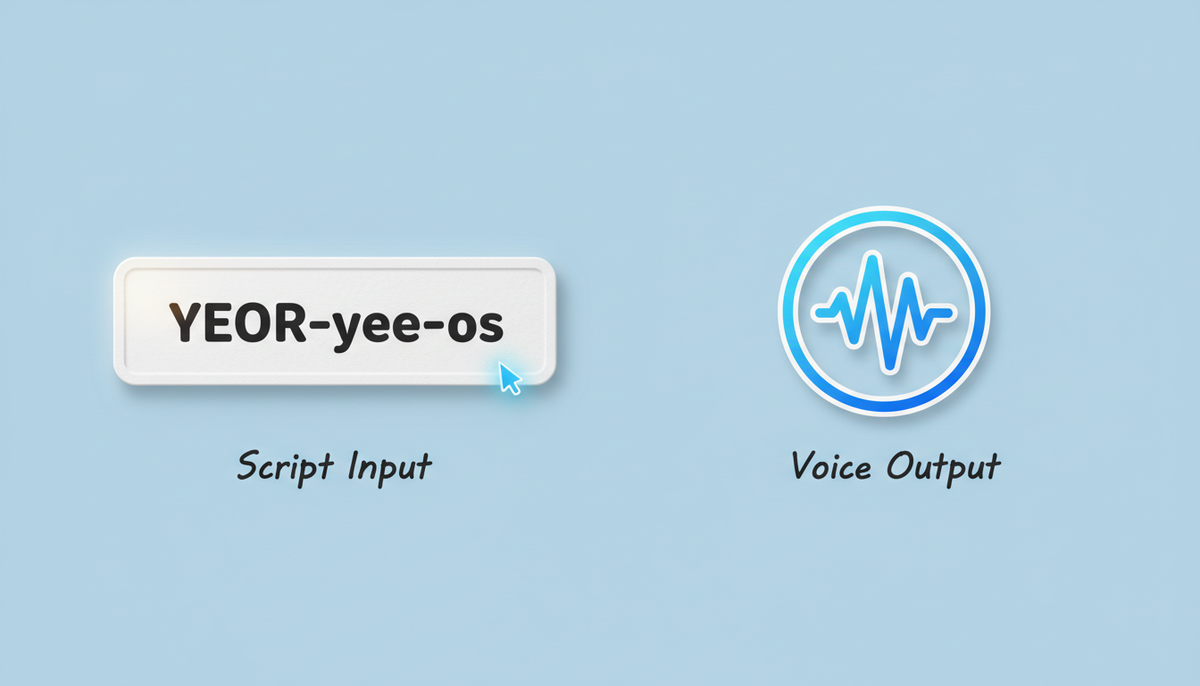
To get an AI voice generator to pronounce Greek names correctly, you must replace Greek spelling rules with English phonetic equivalents and capitalize the stressed syllable in your script. For example, instead of writing "Georgios," you should write "YEOR-yee-os." Because standard English text-to-speech engines apply English pronunciation rules, they often misread Greek letter combinations like "ou" or "ei." Adjusting the spelling ensures your AI characters on Fanfun deliver natural-sounding voice and video messages that respect the recipient's name.
Why Greek Names Require Phonetic Adjustment
AI voice models default to English phonetic rules, which frequently misfire on Greek vowel clusters and consonant combinations. In Greek, the letter combination "ou" is pronounced like the "oo" in "boot," but an AI might read it as "ow" (like in "out"). Similarly, "ei" is pronounced as a long "ee," but text-to-speech software might interpret it as "ay" or "eye."
The goal is not to change how the name is written on cards or visual templates, but to provide an oral "pronunciation key" inside the script text box. On Fanfun, where you can turn your script into a personal video gift or a custom voice note, a small phonetic adjustment makes a difference in the final quality of the audio. It keeps the character's performance immersive. This challenge isn't unique to Greek; similar strategies apply when writing phonetic spellings for unique names or managing phonetic spellings for Polish names.
A Framework for Phonetic Transcription
To transcribe a Greek name for an AI engine, focus on two main elements: identifying the primary stress and mapping the sounds to English equivalents. Greek names always feature a stressed syllable, which is marked by an accent in written Greek. Because AI models ignore these accents, you can guide the voice's pitch and emphasis by using capitalization for the stressed syllable.
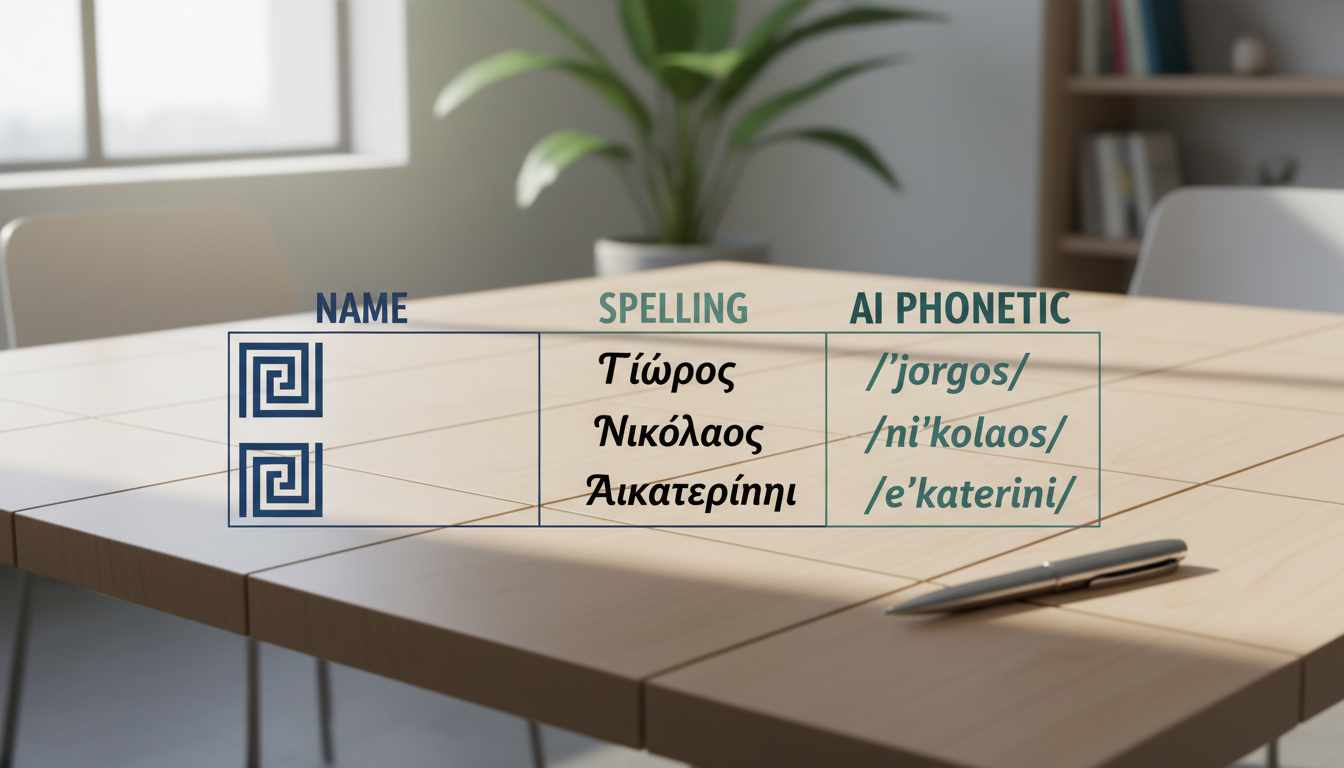
Use these common mappings to convert Greek sounds into English-friendly text:
- The "ou" sound: Map to "oo" (e.g., Soula becomes "SOO-lah").
- The "g" sound: Before "e" or "i" sounds, it sounds like a "y" (e.g., Giorgos becomes "YEOR-gos").
- The "v" sound: In modern Greek, "b" is pronounced like "v" (e.g., Vasilis becomes "vah-SEE-lees").
- The "ch" sound: This is often a soft guttural sound, which can be approximated with "kh" or a soft "h" (e.g., Charis becomes "KHA-rees").
The table below provides a quick reference for common Greek names and how to write them in your script:
| Standard Name | Greek Accent Pattern | Phonetic Script for AI |
|---|---|---|
| Georgios | Ge-ÓR-gi-os | YEOR-yee-os |
| Dimitris | Di-MÍ-tris | dee-MEE-trees |
| Anastasia | A-nas-ta-SÍ-a | ah-nah-stah-SEE-ah |
| Papadopoulos | Pa-pa-DÓ-pou-los | pa-pa-DOP-oo-los |
| Thanasis | Tha-NÁ-sis | thah-NAH-sees |
If you are working with names from other origins, you can apply similar phonetic rules, such as those we cover in our guide for Spanish names.
Testing and Refining Your Script
Different AI voice models may interpret phonetic spellings with varying results. What sounds effective with one voice model might require a slight adjustment for another. Because of this, it is always wise to test your script in small segments first.
We recommend creating a short voice note on Fanfun to hear how the name sounds before committing to a full video gift. If you plan on sending messages to the same recipient frequently, keep a "pronunciation cheat sheet" with their phonetic name saved. For double-barrelled or hyphenated names, you can also consult our guide on how to pronounce hyphenated names to ensure the transition between the two names sounds fluid.
Should I use phonetic spelling for the entire script or just the name?
Only use phonetic spelling for the name or specific words the AI struggles to pronounce. Standard English words should be spelled normally, as the AI voice generator is already optimized to read them correctly.
Will phonetic spellings look strange if the AI displays text on screen?
If your video template displays the script as subtitles, the phonetic spelling will appear on screen. To avoid this, you can choose templates that do not show captions, or adjust your visual settings if the platform allows separate subtitle and voice tracks.
How do I handle double consonants in Greek names?
Double consonants in Greek names, like the double "l" in Vassilis, are usually pronounced as a single consonant in modern Greek. You can simplify them in your phonetic script (e.g., "vah-SEE-lees") to prevent the AI from over-enunciating the sound.