How to Build a Character Persona for Your Brand
Move past generic brand-archetype quizzes. Learn how to build a highly specific, deployable character profile that brings your brand to life across social media and video campaigns.

To build a character persona for your brand, you must define a consistent backstory, establish specific vocal parameters, set conversational boundaries, and map out how that character interacts with your audience. Unlike static brand voice documents that rely on vague adjectives like "professional yet friendly," a functional character persona operates like a living script. This structured profile allows creators, copywriters, and creative teams to produce highly engaging, on-brand content across video, audio, and social media platforms.
The Core Elements of a Modern Brand Character Persona
Traditional brand guidelines often fail because they are too abstract. When a style guide instructs creators to be "authentic and innovative," different writers will inevitably interpret those terms in different ways, resulting in disjointed social media posts and disconnected videos. A character persona solves this by providing a concrete identity that anyone—including external creative partners—can step into.
A complete brand character persona relies on four foundational pillars:
- Backstory (The "Why"): This is the character's origin and motivation. Why do they exist in your industry? An organic skincare brand's character might be a seasoned herbalist who grew up on a farm, while a financial tech app's character might be an analytical strategist who hates hidden fees.
- Vocal Cadence (How They Talk): This defines the rhythm of their speech. Do they use short, punchy sentences, or long, explanatory thoughts? Do they use industry slang, or do they simplify complex terms for beginners?
- Conversational Boundaries: This sets clear rules on what the character will and will not discuss. It also dictates how they handle sensitive topics, competitors, and mistakes.
- Relationship Style: This defines how the character views the customer. Are they an encouraging coach, a witty peer, a protective guide, or a playful contrarian?
By establishing these pillars, you create a reusable creative blueprint. This ensures that whether you are writing an email campaign, scripting a video, or planning a social media series, the voice remains instantly recognizable.
A Step-by-Step Framework to Design Your Brand Character
Building your persona requires translating abstract values into concrete behavioral rules. Follow this three-step framework to document your brand character.
Step 1: Define the Character's Dynamic and Perspective
Determine the primary relationship your character has with your audience. Avoid trying to make them everything to everyone. If they are a witty peer, they should not suddenly sound like an academic textbook. Establish their core worldview and how it drives their daily interactions. For a deeper look at structuring these traits for dynamic interactions, see our guide on designing a high-fidelity roleplay persona.
Step 2: Establish Specific Vocal Parameters
Document the exact mechanics of their speech. List their favorite transition words, preferred punctuation (e.g., do they use exclamation points or keep things understated?), and any signature catchphrases. Equally important is a list of forbidden jargon—words that do not fit their personality and must be avoided.
For example, look at how highly specific thematic constraints dictate scriptwriting in our breakdown of how to script and direct cinematic AI video invitations. In that scenario, the character's gothic, theatrical persona completely reshapes how a standard event invitation is delivered.
Step 3: Define the Reaction Matrix
Determine how your character reacts to different scenarios. Create a simple table or guide showing how they respond to a customer compliment, a technical issue, or a trending pop-culture moment. This keeps the performance consistent even during unexpected events.
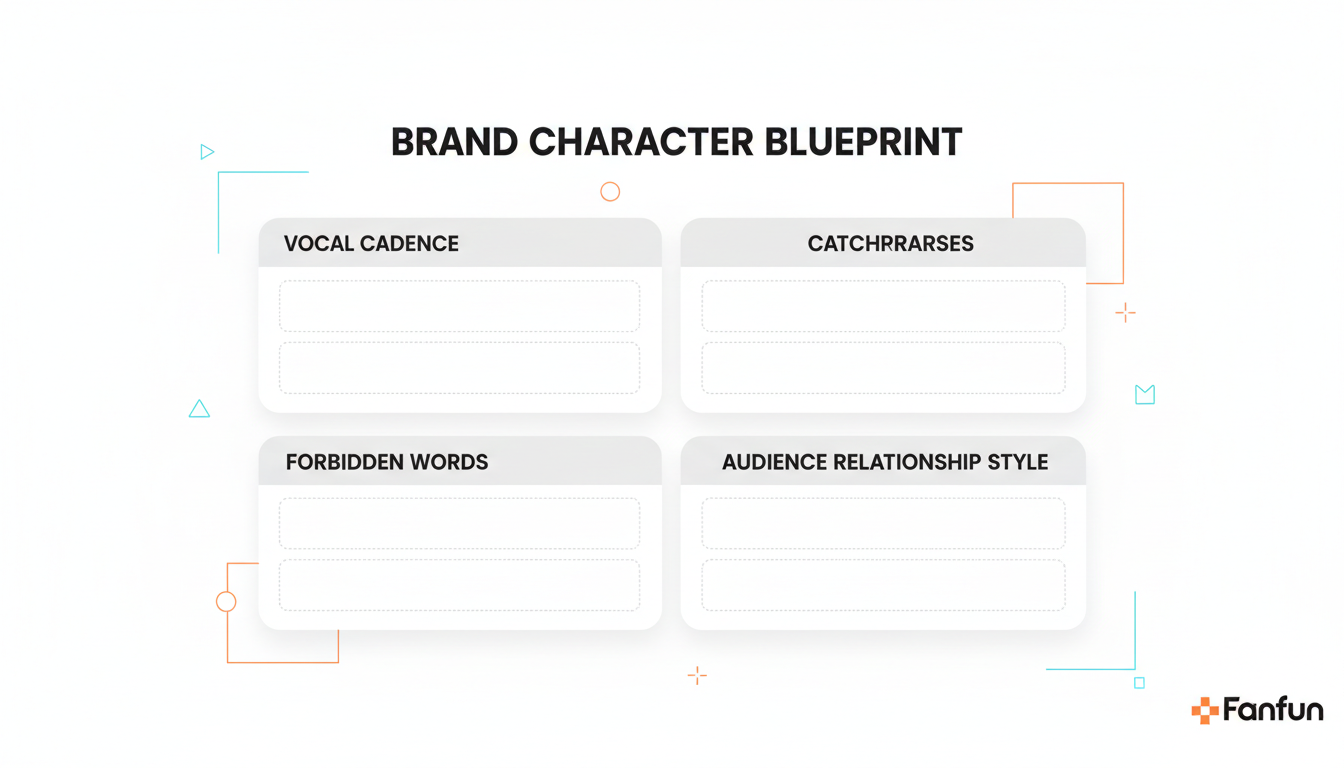
Illustrative Template: The Brand Character Blueprint
Use this customizable framework to map out your own character's traits. The examples below show how two distinct brands might fill out the blueprint.
| Persona Dimension | The Friendly Tech Guide (Example) | The Witty Creative Rebel (Example) |
|---|---|---|
| Core Role | Patient, encouraging mentor who demystifies complex software. | No-nonsense peer who calls out boring design trends. |
| Sentence Structure | Short, step-by-step sentences. Uses analogies frequently. | Punchy, conversational, and uses slight ironies. |
| Signature Phrases | "Let's break this down," "You've got this." | "Let's be honest," "Please stop doing this." |
| Forbidden Words | Synergy, paradigm shift, leverage, basic. | Synergy, optimized, industry-standard, luxury. |
| Handling Mistakes | Reassuring: "No worries, here is how we fix it together." | Direct: "Well, that didn't work. Let's try something bolder." |
How to Deploy Your Brand Character Across Video and Audio
Once your character profile is documented, you need to bring it to life across your marketing channels. A persona is only useful if it is actively producing content that resonates with your audience.
Directing Video Content with Character-Driven Narration
When creating short-form video content for platforms like Instagram or TikTok, your character's voice must hook the viewer immediately. Use your vocal parameters to write scripts that sound spoken, not read. Learn how to translate these traits into engaging social video scripts with our guide on character-driven narration for Instagram Reels. Focus on pacing and emotional delivery that align with the character's core role.
Scaling Creative Output with Character Voice Tools
While developing a proprietary, custom-cloned brand voice requires enterprise-level development and studio recording, creators can learn a great deal by studying how established characters engage audiences. If you want to experiment with high-impact character moments in your campaigns, platforms like Fanfun allow you to select pre-existing, highly recognizable characters to generate custom video messages, roasts, or greetings in minutes. This is an accessible way to test how your audience responds to stylized, character-driven content before investing heavily in a custom build.
To understand how these tools are used to construct narrative depth, explore our guide on how to use a virtual character voice generator to build immersive audio stories. Additionally, writing for an established voice requires a strong grasp of dialogue mechanics. To practice this, you can study how to simulate authentic character interactions for fan content, which provides a framework for matching an existing persona's speech patterns and behavioral quirks.
The Theory of Interactive Touchpoints
For brands looking toward the future of audience engagement, the ultimate goal is two-way interaction. While training a custom, secure customer-facing AI chatbot on your proprietary Brand Character Blueprint requires dedicated engineering, understanding the conversational logic behind these systems is highly valuable. To explore how developers and creators structure dialogue trees and memory retention for virtual representatives, read our analysis on how to set up interactive AI character chats for deeper roleplay immersion.
What is the difference between a brand archetype and a brand character persona?
A brand archetype (like "The Hero" or "The Explorer") is a broad psychological category used to align a company's high-level brand positioning. A brand character persona is a highly specific, actionable profile that defines exactly how that archetype speaks, acts, and reacts in daily content creation, complete with vocabulary rules, backstories, and conversational limits.
Can a small business use a fictional character persona without confusing customers?
Yes, provided the relationship is clear. Customers enjoy character-driven content when it is entertaining and helpful. The key is transparency; do not present a fictional character as a real employee. Instead, position them as your brand's official mascot, guide, or virtual representative.
How do we maintain consistency if multiple team members write for the brand character?
The best way to maintain consistency is to use a shared Brand Character Blueprint. This document should include explicit examples of what to say and what not to say, along with a reaction matrix. Regularly auditing published content against this blueprint helps keep all writers aligned on the same vocal style.