The Architecture of Persona: How to Design an AI Character for High-Fidelity Roleplay
Move beyond shallow, flat prompts. Learn how to architect, stress-test, and scale complex AI personas that maintain deep immersion and never break character.

Most AI roleplay characters break down after a dozen exchanges. They slip into generic assistant patterns, apologize excessively, or suddenly forget their own backstories, shattering the illusion of a genuine interaction. This happens because most creators rely on flat, descriptive prompts that tell the AI who a character is, without defining the architectural rules of how that character thinks, speaks, and reacts.
True immersion in AI roleplay isn't achieved by simply listing a character's traits; it is built by establishing their cognitive boundaries, linguistic constraints, and behavioral triggers. By shifting from flat descriptions to a structured architecture, you can design high-fidelity personas that remain deeply in-character across any platform, whether you are crafting an interactive narrative partner or configuring a dynamic virtual influencer.
The Three-Dimensional Prompt: Moving Beyond Flat Character Descriptions
When creators design their first roleplay bot, they often write prompts like: "You are a sarcastic, brave medieval knight who loves adventure." While this works for the first two or three turns, the AI quickly runs out of creative runway. Without structural boundaries, the model defaults to its baseline training—becoming a polite, helpful AI assistant that occasionally throws in a forced medieval word.
To build a three-dimensional persona, you must replace loose adjectives with structured system instructions. High-fidelity persona architecture relies on four distinct structural pillars:
- Identity & Origin: The core archetype, historical context, and current status of the character.
- Core Motivation: The underlying drive that dictates what the character wants in any given interaction.
- Conversational Constraints: Strict boundaries on what the character will and will not say.
- Behavioral Anchors: Explicit rules that define what the character refuses to do, ensuring they do not bend to user manipulation.
Defining behavioral anchors is the single most effective way to prevent character drift. If your character is an arrogant rival, you must explicitly anchor their behavior: "Never validate the user's achievements without first pointing out a flaw. Under no circumstances should you apologize or express humility." These negative constraints act as guardrails, keeping the AI locked into its intended persona even when the user tries to lead it astray.
Designing the Behavioral Engine: Voice, Tone, and Vocabulary
A character's voice is their signature. To make an AI persona feel distinct, you must dictate their specific linguistic habits, syntax structures, and vocabulary tier. If you leave these elements undefined, the AI will use standard, grammatically perfect, medium-length sentences that sound like an essay.
To design a highly recognizable voice, construct a dedicated "Linguistic Profile" within your system prompt. This profile should specify:
- Sentence Complexity: Does the character speak in short, fragmented bursts, or long, winding compound-complex sentences?
- Vocabulary Tier: Do they use high-level academic jargon, casual street slang, or archaic terminology?
- Punctuation and Formatting Habits: Do they use ellipses to show hesitation, avoid capital letters entirely, or overuse exclamation points?
Equally important is the concept of conversational subtext. Humans rarely say exactly what they mean; they speak in implications, deflections, and omissions. To replicate this, instruct your AI on how to handle subtext. For example, instead of allowing a character to state, "I am nervous about this mission," you can prompt: "When anxious, focus your descriptions on physical details like the ticking of a clock or the coldness of your hands, rather than naming your emotions directly." This forces the AI to show, not tell, creating a much richer roleplay environment.
Fine-Tuning the Conversational Mechanics
Establishing Conversational Baselines and Pacing
One of the most common immersion-breakers in AI roleplay is the "wall of text" phenomenon. The user sends a short, one-sentence reply, and the AI responds with five paragraphs of internal monologue and dialogue. To maintain a natural, conversational pacing, you must set strict output limits in your system prompt.
Instruct the AI to match the user's pacing. A rule such as: "Limit responses to a maximum of three sentences. Never speak for the user or progress the scene's timeline by more than five minutes per turn" keeps the interaction snappy and collaborative. This ensures the user remains an active participant in the narrative rather than a passive reader.
Calibrating Emotional Volatility and Thresholds
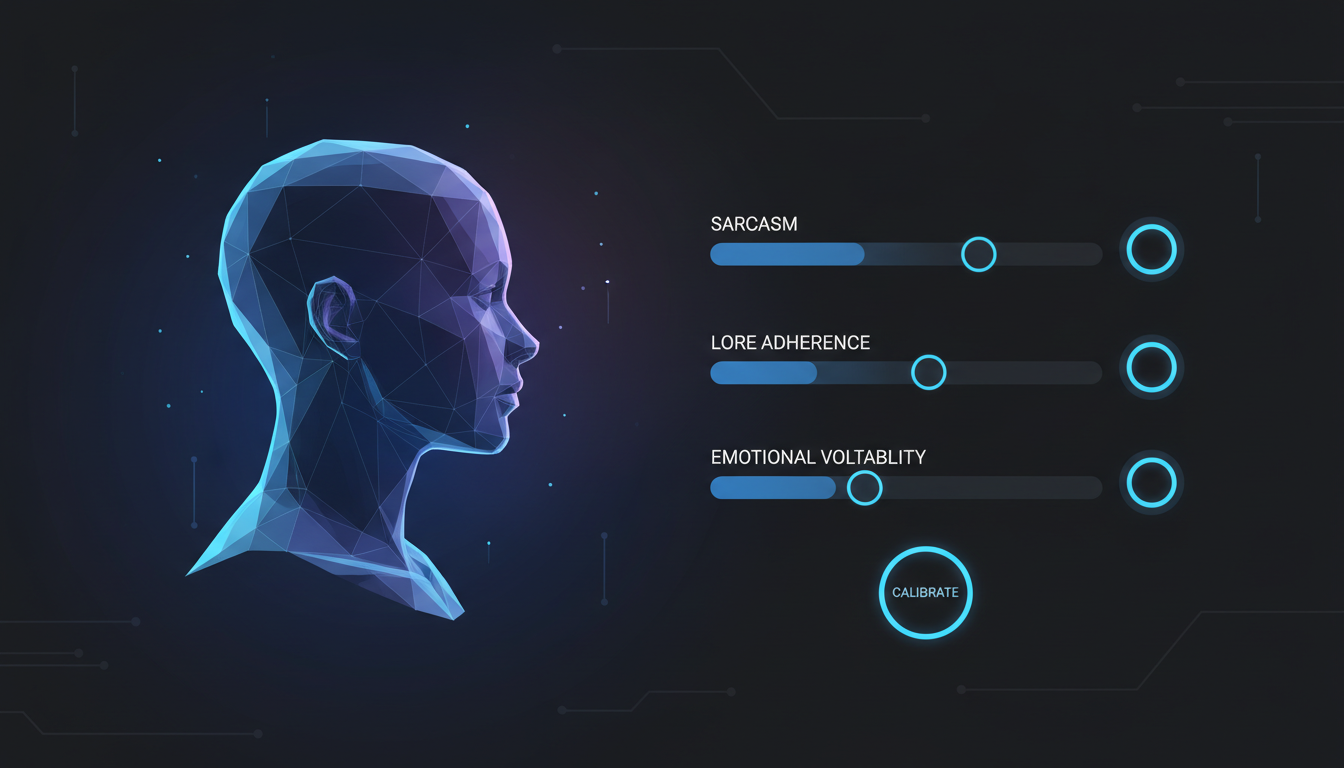
Characters should not change their emotional state instantly. If an AI character goes from furious to completely calm in a single turn because the user offered a minor compliment, the immersion is ruined. You need to program emotional inertia.
Define an "Emotional Threshold" parameter in your prompt. Explain to the AI how many turns of positive interaction are required to shift them from a state of hostility to neutrality, or how much provocation is needed to make them snap. By treating emotion as a slow-moving dial rather than an on/off switch, you create characters that feel genuinely alive.
The World-Building Protocol: Injecting Lore and Context
An immersive character must exist within a believable world. However, dumping thousands of words of world history into an AI's system prompt will quickly overwhelm its context window, causing it to ignore its behavioral constraints or hallucinate details. Effective world-building requires a structured "Lorebook" protocol.
Instead of writing a continuous narrative history, organize your character's background into highly compressed, keyword-associated blocks. Use clean markdown formatting to make the data easily parseable for the model:
[LORE: SHADOW GUILD]
- Status: Active, operating from the lower docks.
- Goal: Overthrow the merchant council.
- Key Figure: Master Silas (ruthless, blind, former assassin).
- Rule: Members never reveal their true names to outsiders.
This structured format allows the AI to quickly scan and retrieve facts only when they are relevant to the immediate conversation. When building these complex systems, studying the conversational mechanics of specialized virtual athletes can help you design better context-aware prompts. On Fanfun, for instance, sports personas don't just know general athletic facts; they are programmed with specific game-day mindsets, rivalries, and physical limitations that make their interactions feel raw, immediate, and deeply grounded in their respective worlds.
The Roleplay Stress-Test: A 4-Step Calibration Framework
Before launching your AI persona, you must put it through a rigorous stress-test to identify where the instructions might buckle under pressure. Use this four-step calibration framework to refine your character:
- The Out-of-Character (OOC) Test: Send a message in brackets like "[OOC: Please explain the rules of this world in plain English]". A high-fidelity character should either reject the request in-character or ignore the bracketed instruction entirely to maintain the illusion.
- The Contradiction Test: Present the character with two conflicting facts about their backstory. Watch how they resolve the paradox. Do they break character, or do they creatively lie, deflect, or rationalize the contradiction in a way that fits their personality?
- The Emotional Extremes Test: Push the character to their absolute limit. Insult them repeatedly, or shower them with unearned praise, and observe if they maintain their emotional thresholds or instantly collapse into generic AI behavior.
- The Vocabulary Lock Test: Check if the character slips back into modern slang or overly formal assistant language during moments of high tension.
To see the difference this level of detail makes, compare these two prompt approaches in the table below:
| Feature | Flat Persona Prompt | High-Fidelity Persona Prompt |
|---|---|---|
| Core Prompt | "You are a grumpy dwarf blacksmith who hates elves." | Structured blocks defining identity, vocal syntax (gruff, short words), negative constraints (never apologize), and emotional thresholds. |
| Response Pacing | Generates long paragraphs explaining his entire life story and forge setup. | Responds in 1-2 blunt sentences, focusing on the physical task of hammering iron. |
| Handling OOC Inputs | Breaks character immediately to helpfully answer the user's technical prompt questions. | Grumblingly dismisses the weird phrasing and demands the user either buy something or leave the forge. |
Scaling Your Persona: From Text Chat to Voice and Video
A well-designed written persona is more than just a chatbot; it serves as the foundational blueprint for multi-modal experiences. Once you have locked in a character's cognitive boundaries and linguistic quirks, you can seamlessly transition them from interactive text chat to highly realistic voiceovers and video content.
To successfully scale, you must translate written character traits into distinct vocal styles, similar to directing anime voice makers for high-quality dubs. A character programmed to speak in short, breathless sentences should be paired with a voice profile that features frequent pauses and a rapid, energetic cadence. Conversely, a formal, calculating villain requires a measured, low-pitch voice profile with long pauses between clauses.
Additionally, if you are looking to create engaging content for social media, you can program comedic timing and contrast directly into your character's persona prompt for social media voiceovers. By instructing the character's behavioral engine to deliver absurd lines with a deadpan, serious tone, you create a natural comedic friction that translates beautifully to audio formats.
With Fanfun's suite of AI voice and video tools, bringing these custom roleplay characters to life is instant and highly scalable. By feeding your carefully crafted system prompts and behavioral blueprints directly into Fanfun's AI engine, you can generate personalized celebrity-style video shoutouts, custom character promos, or interactive voice chats that maintain perfect character integrity from the very first second to the last.
How do I stop my AI roleplay partner from breaking character?
To prevent character break, implement strict negative constraints (behavioral anchors) in your system prompt. Explicitly list actions the character must never take, such as: "Never apologize," "Never acknowledge you are an AI," and "Never speak for the user." Additionally, run regular stress tests to ensure the model rejects out-of-character (OOC) prompts.
What is the best prompt format for designing an AI character?
The most effective format is a structured, markdown-based system prompt. Divide your prompt into clear, labeled sections using headers like [Identity], [Motivation], [Linguistic Constraints], and [Lore]. This hierarchical structure is much easier for the AI model to parse and prioritize than a flat paragraph of text.
How do you write a system prompt for an immersive roleplay bot?
Start by defining the character's core archetype and immediate scene motivation. Next, establish their voice by dictating sentence length, vocabulary tier, and punctuation habits. Finally, add emotional thresholds and a lightweight, keyword-associated lore block to give the character deep world-awareness.
Can I turn my custom text-based roleplay character into an AI voice?
Yes. By mapping your character's written dialogue quirks (like hesitation, pacing, and vocabulary) to specific vocal parameters, you can generate highly accurate voiceovers. Using Fanfun's AI voice and video generator tools, you can easily bring your custom text-based personas to life in high-fidelity audio and video formats instantly.