The Dialogue Sandbox: How to Master New Languages Through High-Stakes Character AI Roleplay
Ditch the repetitive vocabulary drills and step into the dialogue sandbox. Discover how to leverage high-stakes roleplay with AI characters to conquer conversational anxiety, master authentic slang, and build true foreign language fluency.
Learning a new language is rarely a problem of memorizing vocabulary; it is almost always a problem of courage. Traditional language-learning apps keep you locked in a cycle of passive translation drills, prompting you to translate sentences about green apples and library books that you will never actually say in real life. When faced with a live native speaker, your mind goes blank because you have spent hours tapping screens but zero minutes managing the anxiety of real-time communication.
True fluency requires an emotional anchor—a reason to speak that outweighs the fear of making a mistake. By stepping into a "dialogue sandbox" using interactive AI character chat, you can simulate high-stakes conversational scenarios in a completely judgment-free environment. Using Fanfun's interactive AI Chat, you can roleplay with cultural icons, athletes, and fictional heroes, transforming dry grammar exercises into an immersive, high-stakes game where communication is the only way forward.
The Death of the Green Owl: Why Gamified Drills Fail (And Why Character Chat Works)
Gamified language apps excel at keeping you hooked, but they fail at making you fluent. They reward passive recognition rather than active production. When you select the correct word from a multiple-choice list of four options, your brain uses a fraction of the cognitive energy required to construct a sentence from scratch. In the real world, there are no word banks floating in the air. You must retrieve vocabulary, apply grammatical structures, and read social context simultaneously.
Linguist Stephen Krashen's "Affective Filter" hypothesis explains that language acquisition is most successful when a learner's anxiety is low, self-confidence is high, and the input is highly engaging. Standard learning setups often raise this filter. The fear of looking foolish in front of a teacher or native speaker causes your brain to freeze. AI character chat acts as a low-stakes sandbox. The AI doesn't judge, lose patience, or scoff at a misplaced verb. It simply responds, allowing you to lower your affective filter and experiment freely with new phrasing.
This is where Fanfun's interactive AI Chat bridges the gap. Instead of practicing sterile, transactional dialogues like "Where is the train station?", you can engage in emotionally resonant conversations with characters who have distinct personalities, motivations, and speaking styles. When you are trying to convince a legendary detective to help you solve a mystery, or negotiating a trade with an anime protagonist, your brain stops focusing on the mechanics of the language and starts focusing on the objective of the communication. That mental shift is where active fluency begins.
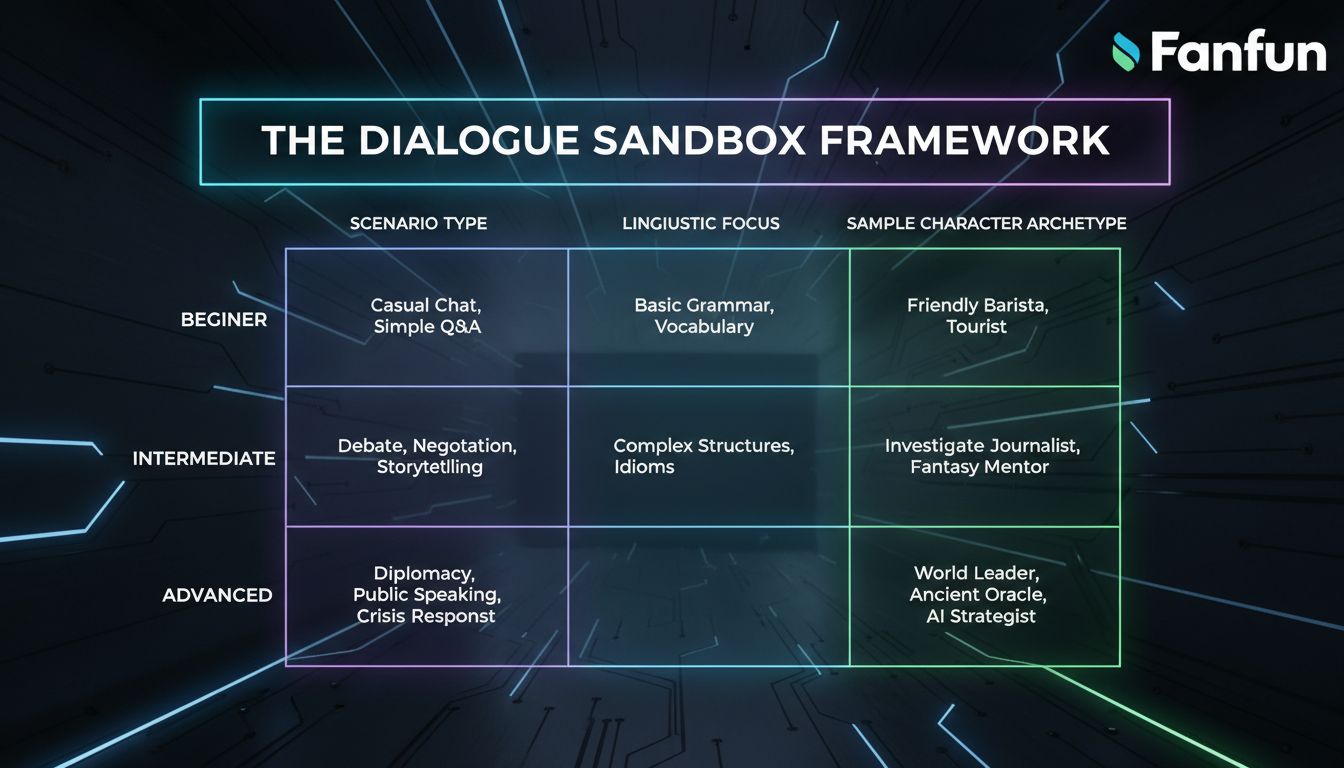
The Dialogue Sandbox Framework: High-Stakes Prompts for Every Fluency Level
To turn character chat into an effective language lab, you need to establish scenarios that force active retrieval. If you simply ask an AI character "How are you?", you will receive a generic response that requires very little linguistic heavy lifting. Instead, you should design "high-stakes" scenarios tailored to your current proficiency level.
The table below outlines how to structure these interactions to maximize your language acquisition at every stage of your learning journey:
| Fluency Level | Scenario Type | Linguistic Focus | High-Stakes Prompt Strategy |
|---|---|---|---|
| Beginner (A1-A2) | Cooperative Survival | Concrete nouns, simple directions, basic needs | The character and the user are trapped in a room. The user must describe items in their backpack to find a way out. |
| Intermediate (B1-B2) | Negotiation & Debate | Conditional tenses, persuasive vocabulary, emotional expression | The user must convince a stubborn character to trade a rare item or agree to a strategic alliance. |
| Advanced (C1-C2) | Crisis Management & Intrigue | Subtle nuance, formal registers, complex storytelling | The user is an advisor guiding a royal character through a political scandal, requiring diplomatic language and fast-paced problem-solving. |
To implement this framework, always set the ground rules in your opening prompt. Clearly establish the target language, the persona of the character, and the specific conflict. For example, if you are an intermediate Spanish learner, you might prompt an AI character: "Let's roleplay in Spanish. You are a legendary captain who has just captured my merchant ship. I must negotiate with you to spare my crew. Speak only in Spanish, use colloquial pirate slang, and do not break character." This immediately establishes context, stakes, and a clear communicative goal.
Choosing Your Conversation Partner: Matching Characters to Your Linguistic Goals
Not all characters are created equal when it comes to language learning. Different character archetypes speak in distinct registers, dialects, and cadences. To build a well-rounded vocabulary, you should actively match your conversational partners to your specific linguistic goals.
Navigating Dialects, Registers, and Social Contexts
If your goal is to master informal, highly expressive, and colloquial dialects, fictional archetypes are incredibly effective. For example, you can use our comprehensive guide on engaging in immersive roleplay with anime heroes to practice informal Japanese dialects and cultural idioms. Anime characters naturally speak with highly emotional, expressive vocabulary and distinct regional accents, making them the perfect tool for breaking away from the stiff, formal textbook speech that often sounds unnatural to native speakers.
On the other hand, if you want to practice action-oriented verbs, motivational phrasing, and rapid-fire strategic thinking, virtual athletes are your best resource. You can explore our guide on talking strategy with virtual athletes to master action-oriented verbs and sports terminology. These interactions are fantastic for learning how to narrate physical movements, discuss fitness and health, and use high-energy imperative verbs in your target language.
For those looking to practice formal dialogue, professional registers, or complex emotional storytelling, dramatic personas and historical figures are ideal. You can consult our guide to chatting with virtual movie stars online for creative roleplay and scene work to learn how to navigate intricate social hierarchies, formal honorifics, and poetic expressions. Fanfun's curated character library allows you to pivot seamlessly between these diverse archetypes, ensuring you never get comfortable speaking in just one register.
The Feedback Loop: How to Correct Mistakes Without Breaking Character
One of the biggest challenges of using AI for language learning is getting corrected without killing the momentum of the roleplay. If the AI stops character to give you a dry grammar lecture after every sentence, the immersive magic of the sandbox is lost. To maintain flow while still improving your accuracy, you can employ two highly effective techniques.
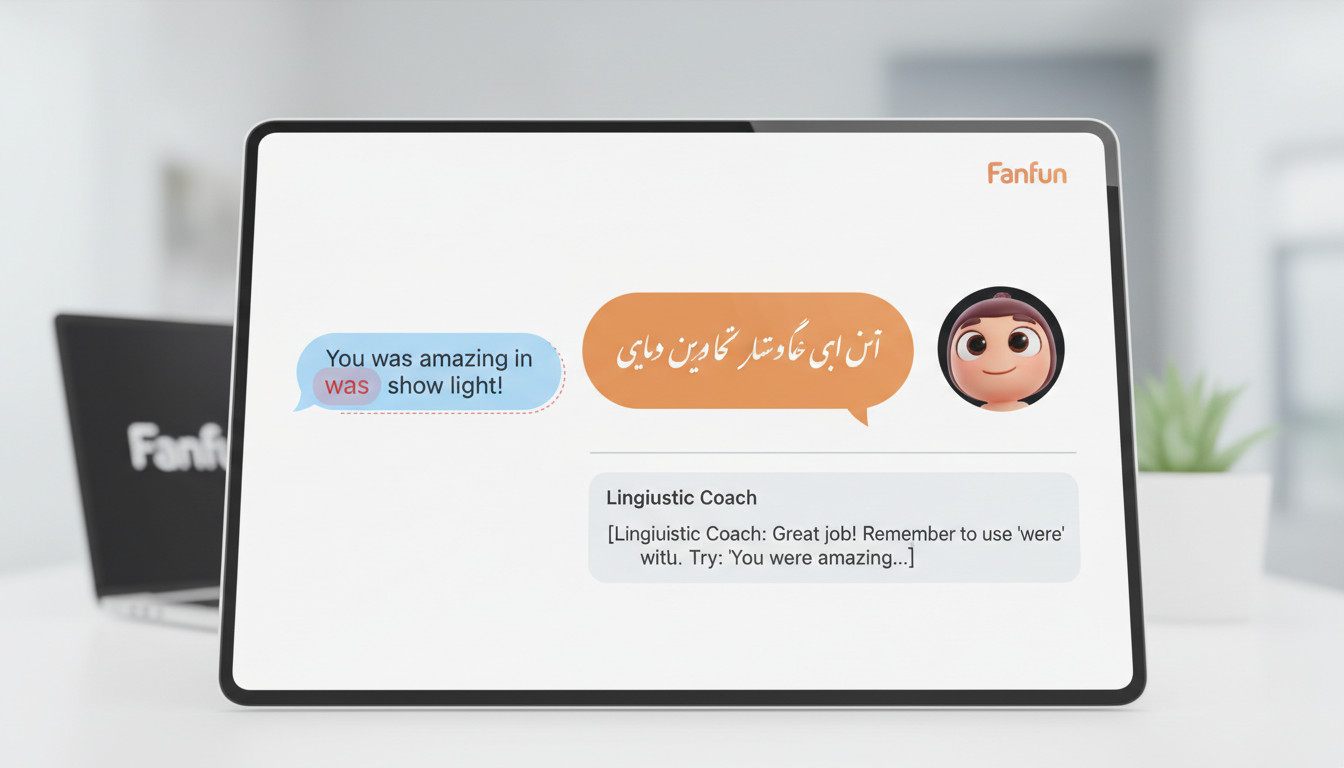
The first is the Dual-Track Prompting technique. At the start of your session, instruct the AI to deliver its responses in two distinct parts. First, it should respond fully in-character, driving the narrative forward. Second, at the very bottom of the message inside brackets, it should provide a brief, polite correction of any grammatical errors you made in your previous turn. This preserves the theatrical illusion of the roleplay while giving you the immediate, targeted feedback you need to learn.The second technique is observing and utilizing Recasting. Recasting is a natural language acquisition tool where a conversational partner subtly repeats what you said, but with the correct grammar or vocabulary. For example, if you write, "I go to the market yesterday," a well-prompted AI character might respond in-character with, "Ah, so you went to the market yesterday? What did you find there?" By paying close attention to how the AI rephrases your input in its responses, you can self-correct on the fly without ever breaking the creative spell. To understand how different platforms handle these nuanced prompting instructions, check out our deep dive on evaluating the best virtual character chat platforms for educational and interactive use cases.
Your Daily 20-Minute Character Chat Routine
Consistency beats intensity when it comes to language acquisition. You do not need hours of study; you simply need a highly focused, daily habit. Here is a step-by-step checklist to integrate character-based roleplay into your daily routine in just 20 minutes:
- Minutes 1-5: The Setup. Open Fanfun, select your character of choice, and paste your structural prompt. Define the language, the high-stakes scenario, and your feedback preferences (such as the Dual-Track method).
- Minutes 5-15: Active Roleplay. Engage in the conversation completely uninterrupted. Force yourself to write or speak without using external translation tools. If you do not know a word, try to describe it using words you do know (circumlocution)—this is a vital fluency skill.
- Minutes 15-20: Review and Log. Read back through the chat history. Copy any corrected sentences or interesting idioms into a personal vocabulary notebook. Finally, ask the AI character to write a quick, one-paragraph summary of your performance and suggest two areas of grammar to focus on tomorrow.
By treating language learning as an active, creative playground rather than a chore, you bypass the boredom that derails most self-directed learners. Step into Fanfun's interactive AI Chat, choose your character, set your stakes, and start speaking your target language with the confidence of a hero on a mission.
Can I really learn a conversational language just by chatting with AI characters?
Yes. Conversational fluency is built through active language production and real-time problem-solving. By chatting with AI characters on Fanfun, you are forced to retrieve vocabulary and construct sentences in response to dynamic, unpredictable prompts, which mimics real-world conversation much better than passive flashcard apps.
How do I get an AI character to correct my grammar without stopping the roleplay?
Use the "Dual-Track" prompting technique. In your very first message, instruct the AI to respond fully in-character first, and then append any grammatical corrections or vocabulary suggestions in brackets at the end of its response. This keeps the roleplay fluid while still providing valuable educational feedback.
What are the best prompts to start a language learning session with an AI character?
Start with a prompt that establishes context, stakes, and rules. For example: "Let's roleplay in [Target Language]. You are a [Character Persona] and we are currently [High-Stakes Scenario]. Speak only in [Target Language], use natural slang, and write a brief correction of my grammar in brackets at the end of each message."
Is AI character chat safe and effective for kids who are learning a second language?
Yes, character chat is an exceptionally engaging way for younger learners to practice. It turns language study into an interactive game. For safe, age-appropriate strategies, check out our guide on using interactive AI character chat for immersive kids' entertainment.