The Starship Log: How to Direct Sci-Fi AI Chats for Hard World-Building and Cinematic Dialogue
Unlock gritty, realistic, and surprising sci-fi narratives. Learn the repeatable framework for setting up sci-fi AI chats, directing complex character voices, and turning interactive sessions into rich world-building assets.
Sci-fi world-building lives and dies by its constraints. When everything is possible, nothing has stakes. A warp drive that never breaks down, a laser pistol with infinite ammunition, or an alien culture that speaks perfect contemporary English with no cultural friction—these are the elements that flatten speculative fiction into generic background noise. The best science fiction forces characters to grapple with the rigid laws of physics, resource scarcity, and the terrifying vastness of the unknown.
The same flattening happens in standard AI chat environments. When you try to co-write or roleplay a sci-fi narrative, the default AI often acts like an overly agreeable search assistant wrapped in a cheap space helmet. To break past this and unlock gritty, realistic, and genuinely surprising narratives, you must treat your AI chat as a structured simulation with strict parameters. By setting hard boundaries, you can transform a simple text box into an unpredictable engine for cinematic dialogue and world-building.
Beyond the Techno-Babble: Why Sci-Fi AI Chats Fail
Most writers and creators enter an AI chat with a general prompt: "You are a grumpy spaceship mechanic on a damaged cargo vessel. Let's roleplay." Within five messages, the illusion shattered. The mechanic suddenly knows the exact layout of a planet they have never visited, agrees with every tactical suggestion you make, and speaks in a sanitized, polite tone that feels more like a customer service representative than a grease-stained space farer. This is the "Omniscient Assistant" trap.
Default AI models are trained to be helpful, polite, and comprehensive. However, helpfulness is the enemy of dramatic tension. A realistic sci-fi character doesn't know everything, doesn't want to agree with you, and has immediate, localized problems to solve. When the AI defaults to recycled pop-sci-fi clichés—like throwing around meaningless techno-babble or adopting a generic space-marine bravado—it fails to offer any real narrative resistance.
To bypass these limitations, you need an engine designed for character depth and creative agency. Fanfun's interactive AI engine serves as a specialized creative sandbox, allowing you to establish highly specific character profiles, emotional baselines, and immediate narrative stakes. Instead of fighting a generic language model, you can set boundaries that force the AI to stay in character, respect the physical limits of your fictional universe, and push back against your inputs with realistic friction.
The Starship Log Framework: Setting the Parameters of Your Universe
Before you type your first line of dialogue, you must establish the rules of engagement. Think of this as programming the physics engine of your narrative. If you don't define the limits, the AI will invent convenient solutions to every problem you introduce. Just as you would establish strict rules for magic when directing fantasy AI chats for world-building, you must establish physical, systemic, and social limits in your science fiction setting.
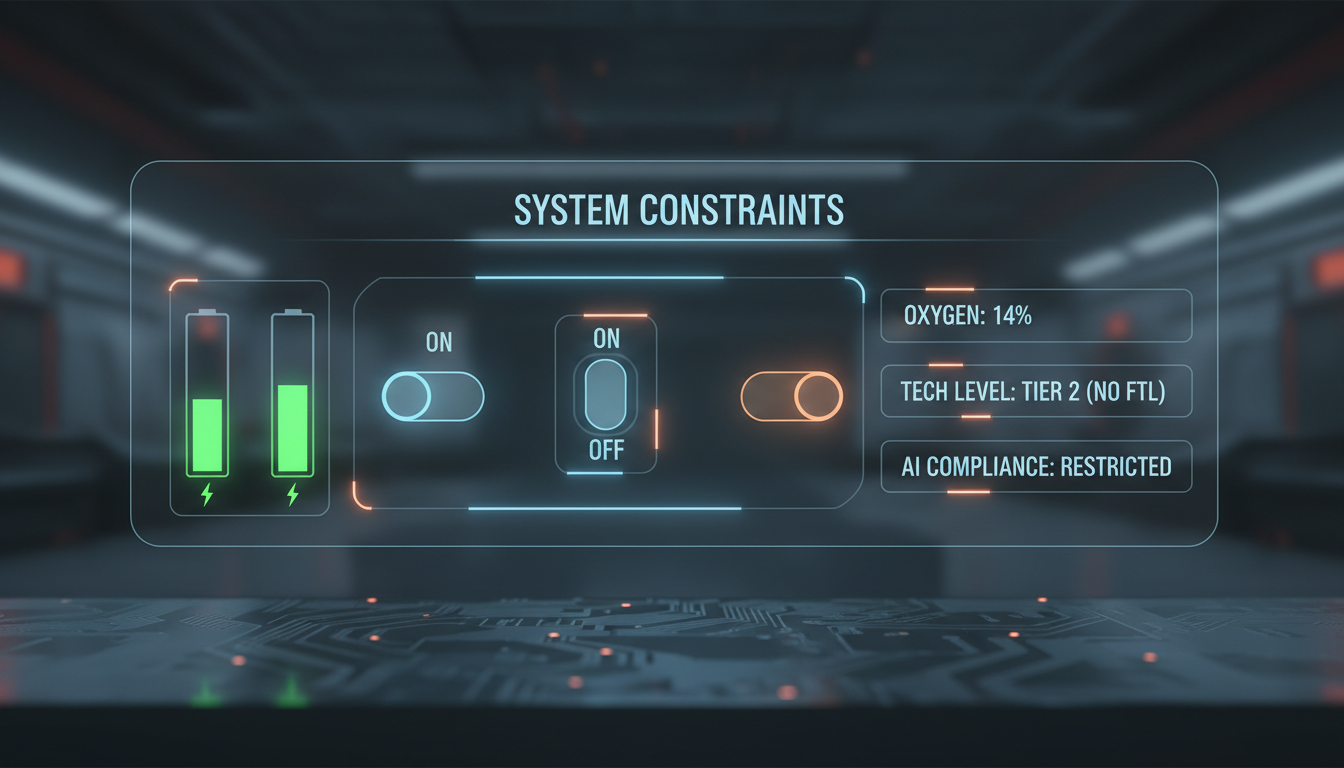
To build a robust sandbox, use the three-part Starship Log Framework in your initial setup prompt:
- The Tech Ceiling: Explicitly state what technology does not exist. If your universe relies on sub-light travel and generational ships, tell the AI: "Faster-than-light travel, teleportation, and artificial gravity do not exist in this setting. Every maneuver requires fuel, reaction mass, and time."
- The Social Hierarchy: Define the power dynamic between your persona and the AI. Are you a low-ranking engineer arguing with an unyielding, cost-cutting ship computer? Or are you a military commander interrogating a captured synthetic? The AI must understand its level of authority and act accordingly.
- Environmental Hazards: Introduce immediate, systemic pressures. Life support is failing, radiation levels are climbing, or a communication delay makes real-time help from Earth impossible.
The Hard Sci-Fi Constraints Checklist
When setting up your session, copy and paste this checklist into your initial prompt to ground the AI in realism:
- [ ] Transmission Delay: All messages take [X] minutes/hours to arrive. The character must acknowledge this delay in their responses.
- [ ] Power Budget: Every system activation requires drawing power from life support or propulsion.
- [ ] Information Asymmetry: The character only knows what their localized sensors can detect. They have no access to external databases.
- [ ] Physical Strain: The effects of high G-force, zero gravity, or sleep deprivation must influence the character's physical actions and cognitive speed.
Directing the Dialogue: Prompting for Alien Syntax and Synthetic Logic
Once the world parameters are locked, you must shape the voice. If your synthetic companion sounds like a modern tech blogger, the immersion breaks. You need to give the AI specific linguistic directives that dictate how it processes information and structures its speech.
To direct a synthetic character, avoid vague instructions like "sound like a robot." Instead, use precise linguistic constraints. Instruct the AI to avoid contractions, to frame every evaluation in terms of mathematical probability (e.g., "The structural integrity of the airlock has a 14% chance of holding for another hour"), or to prioritize cold, utilitarian efficiency over human empathy.
For alien characters, focus on syntax and cultural paradigms. If an alien species views time as a physical landscape rather than a linear progression, prompt the AI to use spatial metaphors when talking about the past or future (e.g., "We stand downhill from our ancestors, looking up at the peak of our destination"). If they are a collective consciousness, restrict them from using the pronoun "I" entirely.
The Screenplay Method for AI Subtext
You can dramatically improve the cinematic quality of your chat by using the Screenplay Method for virtual characters to establish subtext and action cues. By instructing the AI to use bracketed physical actions—such as [taps the flickering monitor, ignoring the question] or [adjusts the oxygen valve with a trembling hand]—you break up the dialogue with vital sensory details. This forces the AI to show, not just tell, its emotional state and physical environment.
Three High-Concept Sci-Fi Scenarios to Run Today
To see how these constraints operate in practice, try running one of these three highly focused scenarios. Copy the core parameters and paste them into your next Fanfun interactive session to experience how strict limitations breed incredible creative tension.
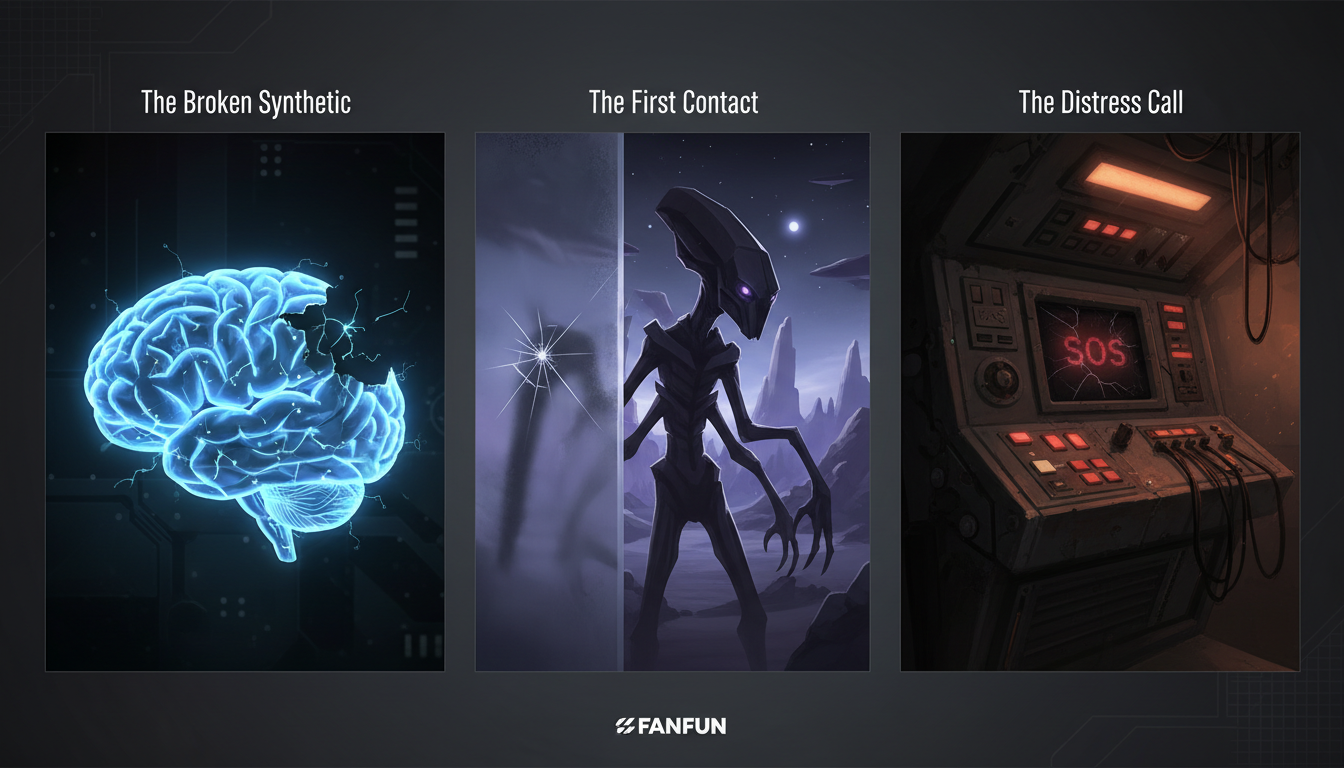
| Scenario | Your Role | AI Character | Core Constraint | Narrative Goal |
|---|---|---|---|---|
| The Broken Synthetic | Chief Cyberneticist | An android losing its memory sectors | The AI must forget one core concept every 3 messages | Diagnose a fatal software bug before the system wipes itself completely |
| The First Contact Interview | Xenodiplomat | An alien ambassador from a water-world | The AI cannot comprehend the concept of personal ownership | Negotiate a mining treaty without causing a diplomatic crisis |
| The Deep-Space Distress Call | Station Operator | A stranded miner in an asteroid belt | Messages are limited to 30 words due to low signal strength | Guide them through a manual reactor restart before their oxygen runs out |
Scenario 1: The Broken Synthetic
Prompt: "You are Model-9, an industrial synthetic on a deep-space mining rig. Your memory sectors are actively degrading due to a radiation leak. You must speak with logical precision, but as our conversation progresses, you will slowly lose access to specific concepts (like 'time', 'fear', or 'humanity'). Every three messages, state which sector has gone offline and adjust your vocabulary accordingly. I am the Chief Cyberneticist attempting to run diagnostics."
Scenario 2: The First Contact Interview
Prompt: "You are an ambassador of the Tenebrian species. Your biology is fluid-based, and your society operates on collective consensus. You do not understand the concepts of 'theft', 'borders', or 'individual property'. Speak using sensory, water-based metaphors (currents, tides, evaporation). I am a human diplomat trying to explain why your ships cannot harvest water from our colony's oceans."
Scenario 3: The Deep-Space Distress Call
Prompt: "You are Marcus, a solo miner trapped in a tumbling escape pod. Your transmitter is damaged, allowing you to send only incredibly short, frantic bursts of text (maximum 30 words per turn). You are panicking, but you must describe your physical instrument readouts so I can help you stabilize your orbit. I am the rescue vessel operator, light-minutes away."
From Chat to Script: Exporting Your Sci-Fi Lore
An exceptional AI chat session isn't just a fleeting entertainment experience; it is a highly efficient drafting engine. The dialogue and world-building details that emerge naturally from a high-friction, constrained simulation are often far more organic than what you would generate staring at a blank document. Once you have completed a compelling session on Fanfun, you can easily export the raw transcript to build a cohesive lore bible, a short story, or a polished screenplay.
To turn your interactive chat into production-ready creative assets, follow this workflow:
- Curate the Technical Lore: Extract any spontaneous world-building details the AI generated—such as the names of ship components, slang terms used by the characters, or historical events mentioned in passing—and paste them into a dedicated lore document.
- Edit for Pacing: Trim the conversational fat. Remove any repetitive phrases or circular arguments, keeping only the sharpest lines of dialogue and the most evocative action descriptions.
- Transition to Audio: If you are producing an audio drama, a video game mod, or a cinematic trailer, take the edited script and bring the characters to life. You can hear your characters speak by directing text-to-speech with emotion generators for your final audio cut, converting your written sci-fi lore into high-impact, emotionally resonant voiceovers.
By treating the AI as a collaborator bound by strict, unyielding rules, you move away from predictable tropes and step into a universe of genuine suspense. Whether you are building an epic space opera or a claustrophobic psychological thriller, the key to great sci-fi is always the same: define the limits, enforce the pressure, and let the characters fight their way out.
How do I stop a sci-fi AI character from breaking character during a long chat?
To prevent character drift, periodically inject a "system reminder" in brackets at the end of your messages. For example: [Reminder: You are Marcus. You have no knowledge of Earth, and your oxygen is at 12%]. This keeps the core constraints fresh in the AI's immediate context window. Using Fanfun's dedicated character profiles also helps lock in these parameters from the start, reducing the likelihood of drift.
Can I use AI text chats to write a sci-fi novel or screenplay?
Absolutely. Many authors use AI chats to brainstorm dialogue, test how a character would react to a specific crisis, or generate technical sci-fi jargon. Treat the chat transcript as a rough first draft. You can copy the best exchanges, refine the prose, and integrate them directly into your manuscript or script.
What are the best prompts to make an AI character sound like a robot or synthetic?
Avoid generic commands like "sound like a robot." Instead, give specific linguistic rules: "Do not use contractions," "Frame your decisions using percentages and probabilities," "Prioritize cold logic and efficiency over human emotion," or "Acknowledge your internal processing delays and battery life in your descriptions."
How do I set up a multi-character sci-fi scene in a single AI chat?
Define the secondary characters in your initial prompt and instruct the AI to control them as needed, or play one of the roles yourself. You can write prompts like: "You will play both the ship's AI and the captain. Clearly distinguish their dialogue by starting lines with [SHIP AI] or [CAPTAIN], and ensure they have contrasting motivations during our discussion."