The Faceless Creator's Guide to AI Voice: Moving Beyond the Robot Monotone
Monotone AI voices are killing your channel's retention. Discover how to treat synthetic narrators as real voice actors through script formatting, strategic pacing, and persona-driven direction.
The faceless YouTube economy is booming, but it has a massive quality problem. Go to any history, gaming, or video essay channel, and you'll likely hear the exact same flat, robotic voice delivering facts with the emotional intensity of a microwave manual. Audiences have developed an acute "bot filter" that triggers the moment they recognize generic, low-effort automation, sending your retention metrics off a cliff.
To stand out in a saturated market, you have to stop treating your AI voice generator as a hands-off text-to-speech tool and start treating it like a digital voice actor that requires active direction. By shifting your approach from simple information delivery to character-driven storytelling, you can build a distinct sonic brand identity that keeps viewers hooked from the first second to the final frame.
Why 'Generic' is the Death of Retention
The primary reason most faceless channels fail to gain traction isn't their visual editing or their topic choice; it's the uncanny valley of their narration. Human ears are highly sensitive to micro-patterns in speech—the slight pause before a dramatic reveal, the rise in pitch when expressing excitement, and the natural drop in volume at the end of a sentence. Standard text-to-speech engines iron these nuances flat, resulting in a hypnotic, predictable drone that prompts viewers to click away.
When you use the same three stock AI voices as thousands of other channels, you strip your content of any unique identity. Your video essay on ancient history or game lore ceases to feel like an immersive experience and begins to feel like a read-aloud Wikipedia page. Successful faceless creators realize that voice selection is not a utility; it is their primary brand asset.
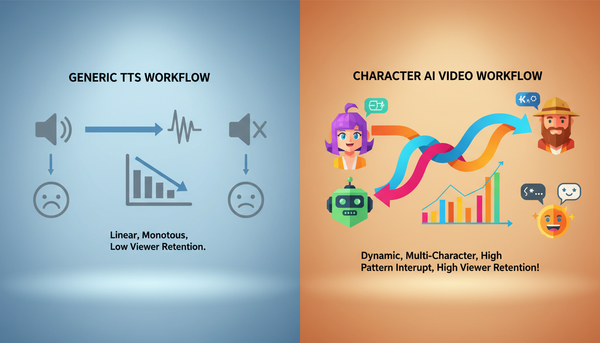
To bypass the audience's natural resistance to synthetic voices, you must transition from corporate-sounding text-to-speech to highly expressive, persona-driven narration. Platforms like Fanfun allow creators to move beyond clinical, sterile voices by offering dynamic AI personas that carry built-in attitude, style, and cultural relevance. Whether you need a voice with the gritty gravity of an action hero or the playful sarcasm of a seasoned pop-culture commentator, selecting a voice with a distinct personality immediately establishes a hook that standard tools cannot replicate.
The Director’s Mindset: Scripting for Synthetic Performance
An AI voice generator is only as good as the script you feed it. If you paste raw, unformatted text designed for reading into a voice generator, the output will sound mechanical. To get a human-like performance, you must write specifically for the ear, using punctuation and formatting to force natural cadences and emotional weight.
This is where the "breathe" technique comes in. When humans speak, we pause to gather our thoughts, emphasize key terms, and build tension. You can mimic these natural human pauses by using non-standard punctuation. Commas, ellipses (...), em-dashes (—), and even strategic line breaks tell the AI generator where to slow down, where to stop, and where to transition between ideas. If you want a deeper look at the mechanics of directing synthetic narrators, check out The YouTube AI Voiceover Playbook for advanced script-formatting strategies.
Below is a direct comparison of how formatting changes the synthetic delivery of the exact same script:
| Unoptimized Script (Flat Delivery) | Optimized Script (Dynamic Delivery) |
|---|---|
| The Roman Empire did not fall overnight. It was a slow decay that took centuries of corruption and civil war to complete. | The Roman Empire... did not fall overnight. It was a slow... painful... decay. It took centuries of corruption—and brutal civil war—to finally bring it down. |
By using italics for emphasis, ellipses for dramatic pauses, and em-dashes to isolate key phrases, you break up the monotonous rhythm that betrays standard AI voiceovers. This simple formatting step transforms a dry statement of fact into a compelling narrative hook.
Selecting Your Channel's Signature Voice
Choosing the right voice requires a systematic approach. You cannot simply pick a voice because you personally like how it sounds; it must align perfectly with your content niche, target audience, and visual style.
The Niche-to-Voice Matching Framework
To help you select the ideal sonic identity for your channel, use this framework to match your content type with the correct voice weight, energy, and tone:
| Content Niche | Voice Weight & Tone | Audience Expectation | Fanfun Persona Strategy |
|---|---|---|---|
| Documentary & History | Heavy, authoritative, warm, slow-paced | Credibility, deep knowledge, cinematic tension | Choose a mature, gravelly narrator persona with a lower pitch. |
| Gaming & Lore | High-energy, expressive, dramatic | Enthusiasm, immersion, community connection | Opt for a dynamic, character-inspired voice that mirrors the game's aesthetic. |
| Pop Culture & Memes | Playful, sarcastic, fast-paced, conversational | Relatability, humor, quick entertainment | Utilize recognizable pop-culture or celebrity-style archetypes to hook viewers instantly. |
When selecting a voice, avoid the temptation to choose a "perfect" voice. Real human voices have imperfections—slight rasps, unique accents, and natural variations in pitch. Choosing a voice with these built-in characteristics makes your narration sound significantly more organic and less like a standard text-to-speech engine.
Refining the Performance: A Practical Workflow
Once you have your script formatted and your signature voice selected, do not simply generate the entire 10-minute audio file in one go. High-retention creators treat the generation process as an iterative workflow to catch and fix synthetic artifacts before they reach the editing timeline.
Start by generating short snippets of your script—typically 2 to 3 sentences at a time. This allows you to check the emotional inflection of specific words. If a word sounds awkward, try spelling it phonetically (for example, writing "pro-cess" instead of "process" or "nay-shun" instead of "nation") to force the AI to pronounce it correctly.
To ensure your final audio meets professional standards, run every generated voiceover through this four-point quality checklist before importing it into your video editor:
- Pacing: Are the pauses between sentences long enough to let the visuals breathe, but short enough to prevent the viewer's mind from wandering?
- Emphasis: Does the AI stress the most important nouns and verbs in the sentence, or does it place weight on filler words?
- Clarity: Are complex terms, names, and industry jargon pronounced flawlessly without slurring?
- Emotional Alignment: Does the energy level of the voice match the tension of the background music and the pacing of the visual edits?
To truly hide any remaining synthetic artifacts, layer your AI voiceover with a robust sound design bed. Adding a low-volume ambient room tone, a well-balanced music track, and subtle sound effects (like swooshes, paper crinkles, or cinematic hits) masks the digital cleanliness of the voice, making it blend seamlessly into the mix. For a masterclass on combining these audio layers to build an immersive listening experience, explore The Audio Drama Blueprint.
Scaling Your Faceless Channel
The ultimate advantage of using AI voice generators is scalability. Once you have dialed in your channel's signature voice, formatted your scripting style, and established your audio post-production workflow, you can produce content at a pace that traditional voice actors cannot match.
Consistency is key to building a loyal audience on YouTube. By using the same voice persona across all your videos, you create a recognizable brand character that viewers associate with your content. This consistency is incredibly valuable when you begin to expand your channel into multi-part series or spin-off formats, allowing you to maintain your established identity without starting from scratch.
Furthermore, this structured workflow allows you to scale your production team. If you decide to hire scriptwriters or video editors, you can hand them your voice guidelines, specific formatting rules, and Fanfun settings to ensure that every video sounds exactly like it was produced by the channel's original creator. For creators looking to integrate these voice assets with custom visuals or animations, reading The Animator's Soundstage can provide a clear blueprint for aligning synthetic voices with complex visual timelines.
By treating the AI voice generator as an active creative tool rather than a passive automation shortcut, you can elevate your faceless channel above the sea of robotic clones, keeping your audience engaged, entertained, and coming back for more.
How do I make an AI voice sound less robotic in YouTube videos?
To make an AI voice sound natural, you must format your script specifically for synthetic speech. Use non-standard punctuation like ellipses (...) for dramatic pauses, em-dashes (—) to break up clauses, and italics to guide emphasis. Additionally, layer your voiceover with a high-quality background music track and subtle sound effects to mask digital artifacts.
Can I use AI voices for monetized YouTube channels?
Yes, YouTube allows monetization for channels that use AI voices, provided the content itself is original, high-quality, and offers significant creative value. YouTube's primary concern is preventing "repetitive" or "low-effort" content, so ensuring your videos feature engaging editing, sound design, and well-directed narration is crucial for monetization approval.
What is the best way to choose a voice for a faceless video essay?
Match the "weight" and tone of the voice to your content niche. For serious history or documentary essays, choose a deeper, slower, authoritative voice. For gaming, pop culture, or commentary, opt for a voice with higher energy, varied pitch, and a more conversational, expressive tone.
How does Fanfun differ from standard text-to-speech generators for creators?
Standard text-to-speech generators offer flat, corporate voices designed for reading documents. Fanfun provides highly expressive, persona-driven AI voices, including character-inspired and culturally relevant personalities. This allows creators to build a unique, recognizable brand identity and inject genuine emotion and style into their narrations.