The Edutainment Blueprint: How to Use High-Personality AI Voice Generators to Keep Students (and Audiences) Awake
Standard text-to-speech tools produce flat, academic drones that kill viewer retention. Discover how to use high-personality, character-driven AI voices to transform dry lessons into dynamic, narrative-driven edutainment.
The standard textbook approach to educational content is rapidly losing its grip on modern audiences. When creators, course designers, or educators rely on flat, robotic text-to-speech (TTS) tools to explain complex concepts, they build an immediate barrier to learning. Audiences do not just tune out; they actively suffer from cognitive fatigue within the first 90 seconds of hearing a lifeless, synthetic drone struggle through a block of academic text.
To keep students and casual viewers engaged, forward-thinking educators are turning to "edutainment"—the seamless intersection of rigorous instruction and high-personality entertainment. By utilizing expressive, character-driven AI voice generators like those available on Fanfun, you can transform dry, academic lectures into highly engaging, cinematic experiences that rival top-tier documentaries and viral social media videos. The secret lies in understanding how to direct these voices to command attention, build trust, and make complex ideas stick.
The Death of the Monotone Lecture: Why Standard TTS Fails in Education
Traditional text-to-speech engines were designed for basic accessibility, not engagement. They excel at reading driving directions or short notifications, but they fail miserably when tasked with keeping a human brain focused on a twenty-minute lesson about quantum mechanics or the French Revolution. This failure is rooted in cognitive science: human brains are hardwired to prioritize social cues, emotional resonance, and vocal variety—a concept known in linguistics as prosody.
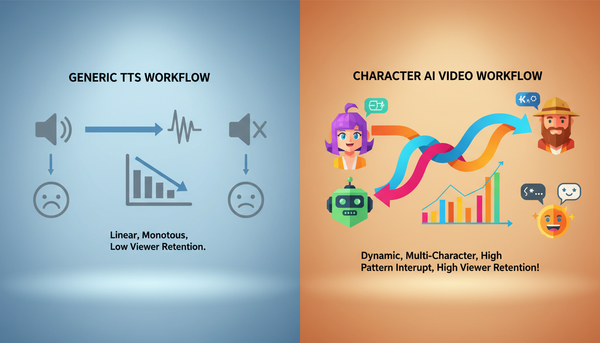
When an AI voice lacks prosody, it delivers every word with the exact same pitch, duration, and intensity. This lack of variation triggers what psychologists call the habituation effect. Because the auditory stimulus is entirely predictable, the brain categorizes it as background noise, much like a humming refrigerator. As a result, the listener's mind wanders, and retention drops to near zero. To make matters worse, the cognitive load required to parse flat, robotic speech drains the listener's mental energy, leaving them exhausted rather than educated.
Modern, high-personality AI voice generators bridge this gap by introducing natural vocal inflections, emotional range, and dynamic pacing. Instead of sounding like a machine reading a database, these advanced systems can sound genuinely curious, deeply authoritative, or playfully sarcastic. By mimicking the subtle shifts in tone that human teachers use to emphasize key points, high-personality AI voices signal to the brain that the information being delivered is novel, important, and worth remembering.
Matching the Voice to the Subject: A Strategic Framework
Selecting a voiceover style should never be an afterthought. The voice you choose acts as the emotional anchor for your entire lesson. If the vocal tone does not match the subject matter, it creates a jarring cognitive dissonance that undermines the credibility of your content. For example, a high-energy, hyper-enthusiastic voice is perfect for a fast-paced physics experiment, but it would feel incredibly disrespectful and distracting when narrating a somber historical documentary.
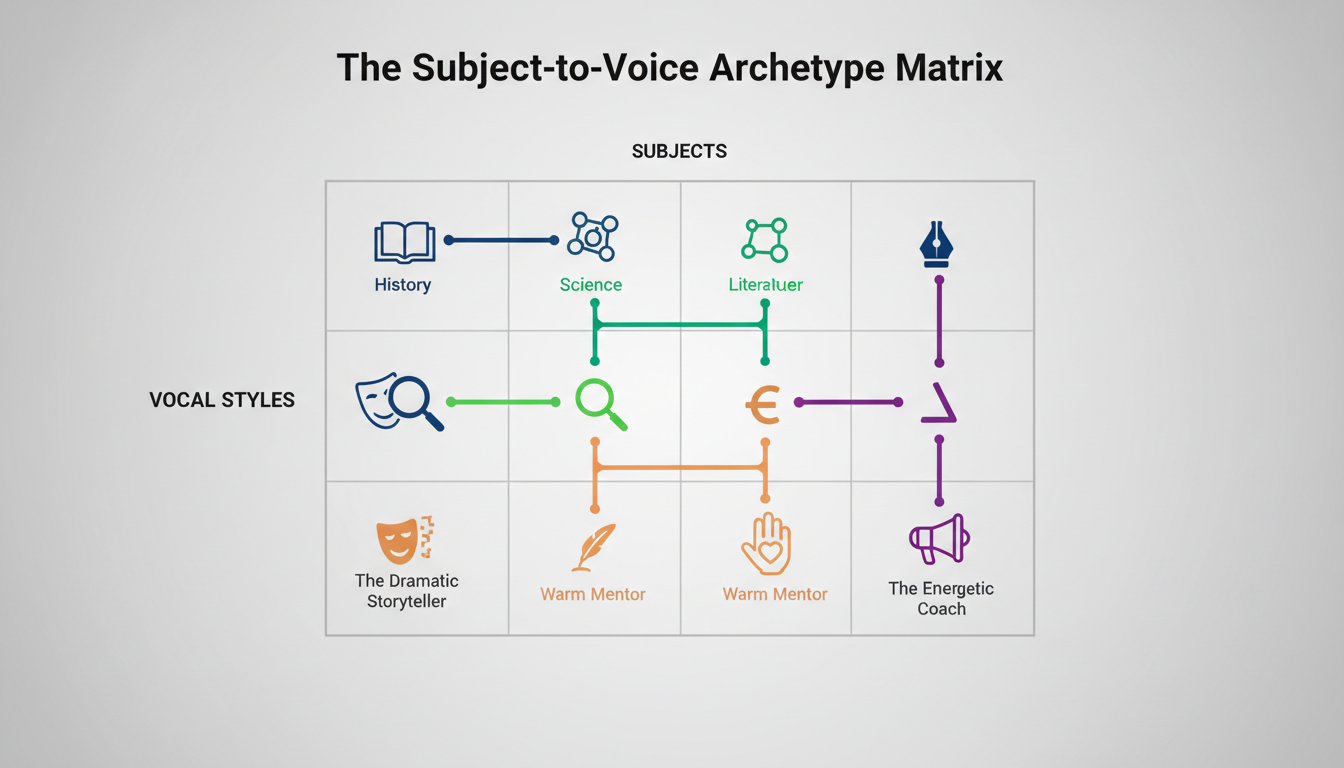
To build trust and maintain authority, you must match your subject matter with the correct vocal archetype. Below is a strategic framework designed to help you align your educational goals with the right vocal delivery:
| Educational Subject | Target Audience | Vocal Archetype | Pacing & Tone | Ideal Use Case |
|---|---|---|---|---|
| History & Social Studies | General Public, Students | The Dramatic Storyteller | Deliberate, warm, and theatrical with deep pauses | Narrating historical turning points and biographical profiles |
| Science & Technology | Tech Enthusiasts, Students | The Curious Explorer | Fast-paced, enthusiastic, and highly expressive | Breaking down complex physics, biology, or coding concepts |
| Literature & Philosophy | Academics, Bookworms | The Warm Mentor | Slow, reflective, soothing, and highly intellectual | Analyzing classic texts, poetry readings, or philosophical debates |
| Mathematics & Finance | Bootcampers, Professionals | The Energetic Coach | Upbeat, rhythmic, clear, and highly encouraging | Step-by-step problem-solving and financial market breakdowns |
The Power of Character-Driven Instruction
Sometimes, traditional academic archetypes are not enough to break through the noise of social media feeds or crowded digital classrooms. In these scenarios, introducing distinct, stylized character voices can make a lesson instantly memorable. Imagine a lesson on astrophysics delivered not by a generic narrator, but by a whimsical, eccentric space traveler, or a grammar lesson explained by a playfully sarcastic cartoon character. If you are pairing these voiceovers with visual assets, refer to our guide on directing custom voice generators for dynamic character animation to ensure your audio and visuals sync up perfectly for maximum comedic or dramatic effect.
Scripting for Retention: Adapting Academic Text for Dynamic AI Delivery
The most common mistake creators make when using AI voice generators is feeding them raw academic text. Textbooks are written for the eye, not the ear. They rely on long, complex sentence structures, passive voice, and heavy clauses that look fine on a printed page but sound incredibly stiff when spoken aloud. To get the most out of an AI voice generator, you must rewrite your material specifically for oral delivery.
Writing for the ear means embracing conversational simplicity. Keep your sentences short and punchy. Use active verbs that drive the action forward, and sprinkle in rhetorical questions to break up long explanations. For instance, instead of writing, "The cellular membrane is composed of a phospholipid bilayer, which serves the function of regulating the entry and exit of molecules," write, "Think of the cell membrane as a highly selective security guard. It decides exactly who gets in, and who gets kicked out." This conversational approach not only sounds more natural but also gives the AI voice generator clear cues on where to place conversational emphasis.
Additionally, you must structure your script to give the voice generator room to breathe. When introducing a complex formula or a dense historical date, follow it with a short, simple sentence to let the information sink in. If you want to master the art of writing highly engaging, auditory-first scripts, check out our guide on scripting and voicing high-retention narration, which breaks down the structural formulas used by top-tier documentary filmmakers.
Directing Your AI Voice: Pacing, Emotion, and Pronunciation Hacks
Once you have a conversational script and the perfect vocal archetype, the final step is fine-tuning the delivery. Even the most advanced AI voice generators sometimes need a little guidance to handle complex scientific jargon, historical names, or unusual foreign terms. With a few simple formatting and editing hacks, you can polish your audio until it sounds virtually indistinguishable from a professional voice actor in a studio.
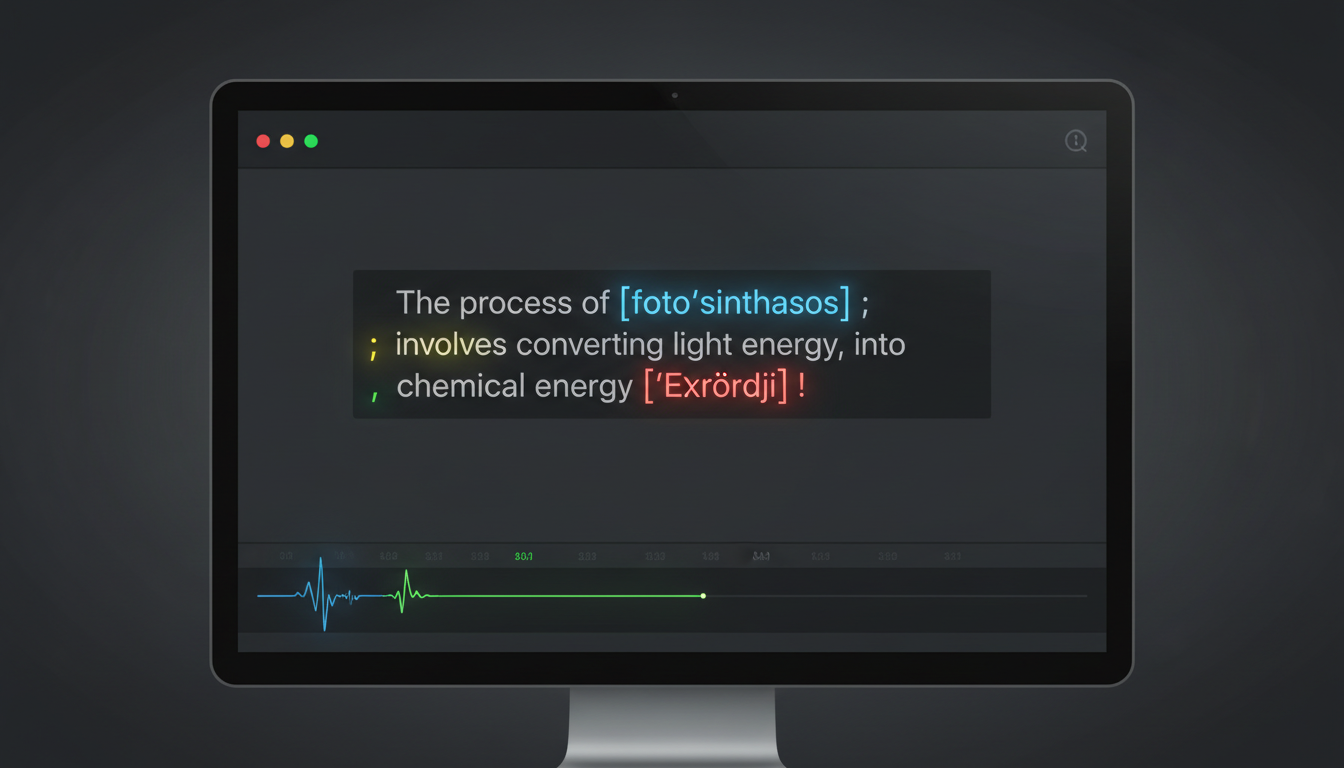
First, master the art of phonetic spelling. If the AI struggles with a technical term like "photosynthesis," try spelling it out phonetically in your text editor as "fo-to-sin-thuh-sis." If you are talking about the French philosopher "Descartes," write it as "day-kart." This simple trick bypasses the AI's standard pronunciation dictionary and forces it to enunciate the syllables exactly how you want them heard.
Second, use creative punctuation to manipulate the AI's pacing and emotional delivery. Standard periods and commas are often not enough to create the dramatic pauses required for great storytelling. Use ellipses (...) to force a suspenseful pause before a major revelation, or em-dashes (—) to create a sudden, energetic shift in tone. If you want to go deeper into these advanced technical adjustments, our blueprint on directing AI voices for cinematic narration offers a comprehensive breakdown of how to use punctuation, line breaks, and formatting to coax true emotional range out of synthetic voices.
Finally, never let your voiceover sit in a vacuum. Layering a subtle, low-volume background track—like a lo-fi beat for math tutorials or a sweeping cinematic pad for history lessons—helps mask any minor digital artifacts and binds the voiceover to the overall mood of the video.
From Classroom to TikTok: Scaling Educational Content with Fanfun
The traditional workflow for producing high-quality educational videos is incredibly slow and expensive. Hiring professional voice actors, renting studio time, and waiting days for revisions can easily drain your budget and stall your production schedule. For independent creators, educators, and social media marketers, this bottleneck makes it almost impossible to keep up with the demands of modern content algorithms.
This is where Fanfun transforms the creation process. By utilizing Fanfun's AI Voice Generator, you can bypass the traditional production hurdles entirely. Instead of waiting days for a voice actor to return a revised file, you can type out your script, select an engaging, high-personality character voice, and generate studio-quality audio in a matter of minutes. This instant turnaround allows you to experiment freely, testing different vocal styles and comedic angles until you find the exact formula that resonates with your audience.
With Fanfun, you can easily scale your content across multiple platforms. You can take a dense, hour-long lecture and break it down into a series of bite-sized, viral TikToks or YouTube Shorts—such as "History Roasts" or quick science memes—using highly expressive, recognizable character voices that immediately stop users from scrolling. By combining rigorous educational value with the undeniable charm of high-personality AI voices, you can turn passive viewers into highly engaged, active learners who eagerly await your next upload.
How do I make an AI voice generator sound less robotic in my educational videos?
To make an AI voice sound natural, you must script for oral delivery rather than writing like a textbook. Use short, conversational sentences, active verbs, and rhetorical questions. Additionally, you can manipulate punctuation—such as using ellipses (...) for dramatic pauses or em-dashes (—) for sudden shifts in tone—and adjust the phonetic spelling of tricky words to force natural-sounding emphasis.
Can I use character AI voices for commercial educational courses?
Yes, many creators use high-personality AI voices to commercialize their courses, tutorials, and training materials. Platforms like Fanfun provide licensed and original AI personas that allow you to generate engaging, professional-sounding voiceovers at scale without worrying about traditional voice actor booking constraints or expensive studio fees.
What is the best way to handle complex scientific terms or jargon with an AI voice generator?
The most effective method is phonetic spelling. If the AI struggles with a complex word like "photosynthesis" or "Descartes," write it out phonetically in your script (e.g., "fo-to-sin-thuh-sis" or "day-kart"). This guides the AI's pronunciation engine to deliver the syllables with natural human cadence and correct emphasis.
Does using a high-personality AI voice actually improve student retention compared to standard text-to-speech?
Absolutely. Cognitive science shows that flat, monotonous voices trigger habituation, causing the brain to filter the speech out as background noise. High-personality AI voices utilize natural pitch variations, emotional range, and dynamic pacing, which keep the brain alert, reduce cognitive fatigue, and significantly improve information retention.