Beyond the Low-Effort Meme: How to Direct a Trump Voice Generator for High-Retention Social Content
Move past cheap parodies and master the complex rhetorical tricks of AI voice generation. Discover how structuring scripts with specific cadence, unexpected character pairings, and professional pacing can elevate your social media content from basic Discord gags to high-retention viral hits.
The initial wave of low-effort AI voice clips—mostly chaotic gaming lobby arguments and simple readings of internet copypastas—has officially run its course. Audiences on TikTok, YouTube Shorts, and Instagram Reels have developed a high tolerance for basic voice cloning, meaning the mere novelty of hearing a famous public figure say something out of character no longer guarantees a high viewer retention rate.
To break through the noise, smart creators are shifting from simple vocal mimicry to high-fidelity narrative satire. By viewing an AI voice generator not as a novelty button but as a complex digital actor with specific rhetorical habits, you can construct highly shareable, serialized content that keeps viewers watching past the critical three-second mark.
The Evolution of the AI Trump Voice: From Discord Gags to Narrative Satire
The massive explosion of the "Presidents playing Minecraft" trend proved that there is a massive, highly engaged appetite for character-driven AI voice content. These early videos succeeded because they placed familiar public figures in absurd, highly relatable gaming scenarios. However, as the market became saturated with identical setups, the novelty faded. Today's viewers can spot a low-effort voice clone within milliseconds, and they quickly swipe away if the content lacks a compelling narrative hook or polished writing.
Modern social media algorithms heavily prioritize watch time and completion rates, which means your content must offer more than just shock value. High-retention satire relies on unexpected scenarios, sharp comedic timing, and deep character dynamics. Rather than relying on simple shock-jock scripts, successful creators are building rich, serialized worlds where characters interact with distinct, highly recognizable personality traits.
To execute this level of production without getting bogged down in complex local software setups, creators need tools that offer both speed and high fidelity. Platforms like Fanfun provide content creators with an instant, scalable creative sandbox. By offering a streamlined interface to generate high-fidelity character voices and interactive dialogues, Fanfun allows you to focus on what actually drives views: the script, the pacing, and the creative concept. This approach transforms a passive listening experience into an active, episodic piece of media that viewers want to follow week after week.
The Anatomy of Trumpian Delivery: Scripting for the AI Vocal Model
To make an AI voice generation sound authentic, you must write for the vocal model's specific linguistic habits. A flat, grammatically perfect script will sound robotic, regardless of how advanced the underlying AI engine is. The key to capturing a convincing delivery lies in mimicking the non-linear sentence structures, sudden parenthetical thoughts, and heavy use of superlatives that characterize the target's natural speech.

Understanding the underlying mechanics of this style is essential for creators who want to build a sustainable audience. For a deeper look into why this specific voice acts as such a powerful vehicle for digital comedy, read our analysis on the rhetoric of AI and why the Donald Trump AI voice is the ultimate tool for satirical content creation.
One of the most critical elements to script is the "verbal pivot." This is the rhetorical maneuver where the speaker transitions abruptly from self-aggrandizement to a sudden, sharp dismissal of critics or competitors. Sentences should rarely finish where they began; instead, they should branch off into brief anecdotes, self-corrections, or declarations of unprecedented success before circling back to the original point.
Mastering Phonetic Prompts and Punctuation
To force the AI engine to capture specific pauses, rising inflections, and natural-sounding stumbles, you must write phonetically. Use ellipses (...) to indicate dramatic pauses, capitalize words that require sudden emphasis, and use hyphenated words to slow down the delivery of key phrases.
Consider this script comparison to see how formatting changes the final vocal output:
- The Flat Script (Robotic Output): "We are going to build a very great product. It will be the best product in the world and everyone will love it."
- The Optimized Script (Natural Rhetoric): "We are building something... and let me tell you, it is beautiful. Nobody has ever seen anything like it. They come up to me—very smart people, scientists, the best—and they say, 'Sir, how do you do it?' And I say, it's easy. It's just... we have the best people. It's going to be huge, okay? Absolutely huge."
To master the exact formatting and syntax required for these scripts, check out our guide on how to structure prompts for AI voice generation.
Generative vs. Real-Time: Choosing the Right Pipeline for Your Content
When building your content pipeline, it is essential to understand the structural differences between real-time voice changers and generative AI voice platforms. Real-time changers are excellent for live-streaming, interactive gaming sessions, or spontaneous audience interactions where low latency is the primary requirement. However, they rely entirely on the user's live vocal performance, which often lacks the precise rhetorical cadence and high-fidelity output needed for polished, highly edited social media videos.
Generative voice platforms, on the other hand, allow for meticulous script editing, pacing adjustments, and layered audio production. By generating the audio from a carefully crafted text script, you gain complete control over the timing, emphasis, and emotional delivery of the performance. Explore our deep dive on why your voice changer needs a rhetorical upgrade to understand the fundamental differences in delivery.
Furthermore, selecting the right platform is about more than just picking a voice; it is about finding a tool that fits your production workflow and respects creative boundaries. For a comprehensive breakdown of how to evaluate these tools, read our guide on how to choose the right celebrity voice generator for your content.
| Feature | Real-Time Voice Changers | Generative AI Voice Generators |
|---|---|---|
| Primary Use Case | Live streaming, gaming lobbies, real-time calls | Highly produced social videos, narrative satire, promos |
| Latency | Ultra-low (instantaneous) | Seconds (generation queue) |
| Emotional Control | Dependent on user's physical voice acting | Controlled via phonetic scripting and AI model settings |
| Audio Fidelity | Moderate (often prone to digital artifacts) | High (studio-grade output) |
| Script Precision | Low (on-the-fly improvisation) | High (pixel-perfect timing and text editing) |
Scripting the Crossover: Pairing the Trump Voice with Unlikely Characters
The most successful viral videos rarely rely on a single voice speaking into a vacuum. Instead, they maximize audience engagement by creating high-contrast, multi-character dynamics. Comedy and narrative tension are naturally generated when you pair a highly energetic, non-linear political voice with an entirely different archetype—such as a calm, philosophical anime guide, a deadpan historical figure, or an epic sci-fi protagonist.
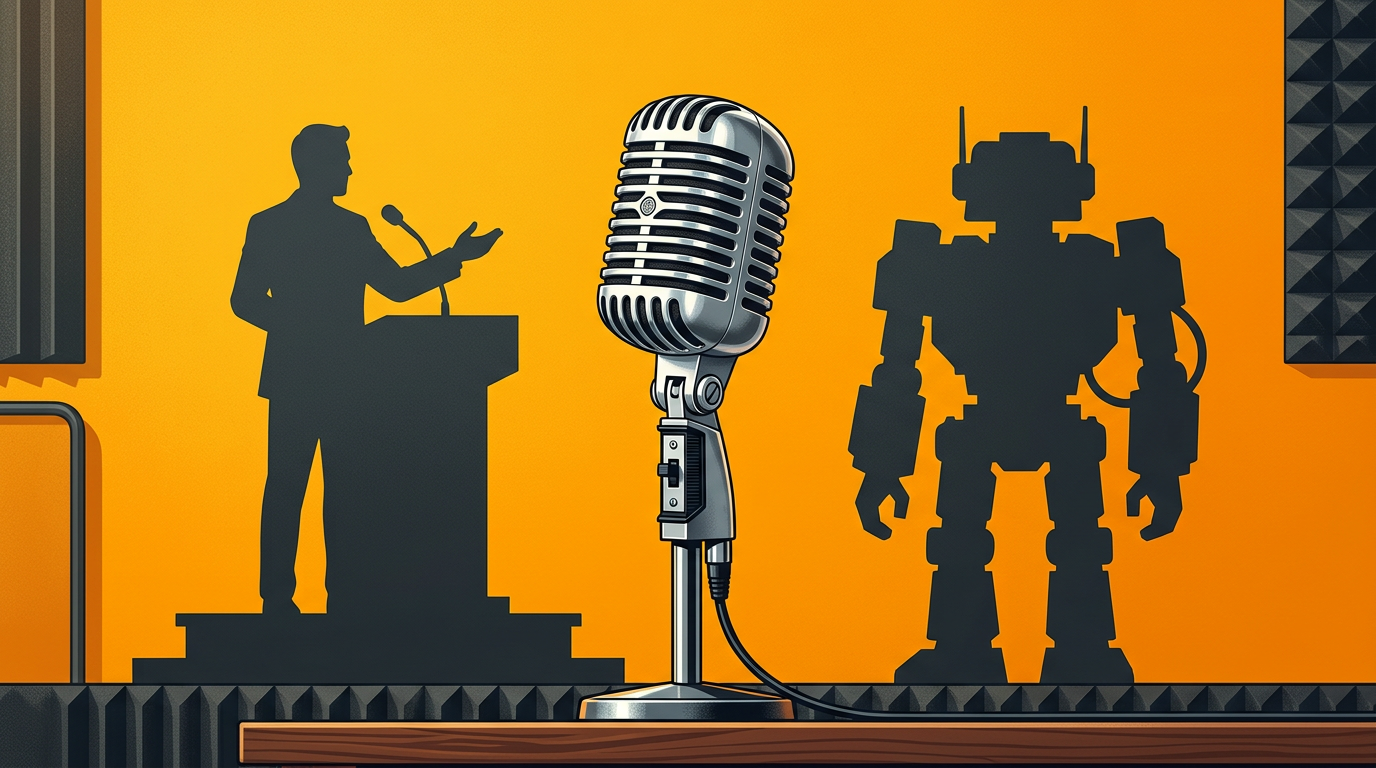
When scripting these crossovers, each character must act as a perfect foil to the other's rhetorical style. For instance, while one character delivers grand, sweeping claims, the other should react with cold, logical precision or dramatic, cinematic gravity. Consider a scenario where a sci-fi commander attempts to deliver a serious, universe-saving speech, only to be interrupted by a hyper-specific critique of their ship's design. Learn how to leverage iconic sci-fi voices for dynamic storytelling in our guide to using an Optimus Prime voice generator.
Using Fanfun's diverse character library, creators can instantly generate multi-character scripts without the logistical nightmare of hiring multiple voice actors or mastering complex audio mixing software. This makes it incredibly simple to test out bizarre pairings—such as a legendary sports coach debating a cartoon character—to see which dynamic resonates most with your target audience. The contrast between high-stakes cinematic gravity and mundane, highly opinionated commentary is a proven formula for keeping viewers hooked through the entire duration of a short-form video.
The Creator's Checklist for Viral Satire Execution
Once you have generated your high-fidelity vocal tracks, the final execution phase determines whether your video holds the viewer's attention or gets skipped. High-retention content requires a meticulous approach to pacing, visual pairing, and platform-specific editing techniques.
For a complete framework on pacing, narrative hooks, and comedic timing, read our full satire playbook for viral parodies. In the meantime, integrate these essential steps into your editing workflow:
- Tighten the Pacing: Edit out dead air between character exchanges, but preserve the natural, deliberate pauses within the generated voice lines to maintain rhetorical authenticity. Every millisecond of silence between speakers is an opportunity for a viewer to swipe away.
- Dynamic Visual Pairing: Match the rhythmic cadence of the audio with fast-paced B-roll, expressive character avatars, or dynamic, colorful captions that pulse to the beat of the speech. Use kinetic typography to highlight key words like "huge," "disaster," or "beautiful."
- Layer Ambient Audio: Add subtle background music, sound effects, or low-volume game footage to ground the dialogue and keep the viewer's auditory senses fully engaged. A low-volume lo-fi beat or cinematic drone can instantly elevate the production value of the entire clip.
- Commit to Ethical Satire: Focus your creative energy on lighthearted parody, fictional scenarios, and pop-culture crossovers rather than spreading misleading real-world misinformation. The goal is to entertain and delight, keeping your content compliant with platform safety guidelines.
How do you make a realistic Trump AI voice?
Creating a realistic AI voice requires more than just a high-quality model; it requires writing a script that matches the speaker's natural speech patterns. Use non-linear sentence structures, sudden self-interruptions, and phonetic spelling (like capitalization for emphasis and ellipses for dramatic pauses) to make the AI delivery sound authentic and lifelike.
What is the difference between a real-time voice changer and a generative voice generator?
Real-time voice changers modify your physical voice instantly as you speak, making them ideal for live streaming and gaming. Generative voice generators convert written text into high-fidelity speech, allowing for precise editing, superior audio quality, and complete control over the pacing and rhetorical delivery of the script.
Can I use a Trump voice generator for parodies on TikTok and YouTube?
Yes, using an AI voice generator for creative parodies, comedic crossovers, and satirical memes is highly popular on social media. To ensure your content remains safe and compliant with platform guidelines, focus on lighthearted, fictional scenarios and clearly label your content as AI-generated satire.
How do I make my AI voice scripts sound more natural and less robotic?
To eliminate robotic monotony, break up grammatically perfect sentences. Write text with natural stumbles, parenthetical asides, and varying sentence lengths. Utilizing platforms like Fanfun allows you to quickly regenerate lines with different emphases until you achieve the perfect, natural-sounding vocal performance.