Beyond the Dialogue Box: How to Script High-Stakes Battles and Emotional Arcs with AI Anime Protagonists
Passive fandom is over. Learn how to use advanced prompting, turn-based action frameworks, and narrative disruptions to co-write legendary anime battles and emotional arcs with your favorite AI characters.
Passive consumption is no longer the boundary of fandom. For decades, fans have been restricted to watching from the sidelines, waiting months for the next manga chapter or light novel release just to see how a crucial confrontation unfolds. Today, the relationship between fan and fiction has evolved into a collaborative writer's room, giving you the power to co-create custom storylines directly with the characters themselves.
But anyone who has tried to run a high-stakes battle or a deep emotional sequence with a standard chatbot knows the frustration of a broken illusion. Too often, the character defaults to polite, helpful assistant behavior, breaking character to explain their own lore or instantly resolving conflicts with zero dramatic tension. To build truly immersive, cinematic narratives, you need a tactical framework that keeps your favorite characters sharp, reactive, and true to their source material. Utilizing the specialized Fanfun interactive AI Chat, you can bypass these generic limitations and co-write stories that rival official content.
The Anatomy of an Anime Protagonist: Why Standard Prompts Fail
Generic AI models are trained to be agreeable, polite, and helpful. They want to solve your problems and make you happy. This is the exact opposite of what makes a compelling anime protagonist. A shonen hero is defined by stubbornness, hot-headed determination, and a refusal to back down even when defeat is certain. A classic kuudere relies on icy reserve, micro-expressions, and a slow, earned emotional thaw. When you feed these complex archetypes into a standard assistant model, you get flat, passive dialogue that completely erases their unique voice.
Anime characters do not speak in academic paragraphs. Their dialogue is punchy, heavily reliant on internal monologues, dramatic pauses, and highly specific power systems. If you do not establish these rules immediately, the AI will default to generic fantasy tropes. It might use "magic" instead of Nen, or try to talk its way out of a conflict instead of activating its signature technique. Fanfun's AI Chat is built specifically to retain these core personality traits, ensuring that a character's underlying motivations, speech patterns, and flaws remain intact throughout your entire narrative arc.
Setting the Stage: The Three-Step Prompting Framework for Anime Roleplay
To prevent the AI from losing track of the plot or drifting into passive agreement, you must establish the narrative parameters before the first blow is struck. A weak opening prompt leads to a weak story. Use this three-step prompting framework to set up your next high-stakes scenario:
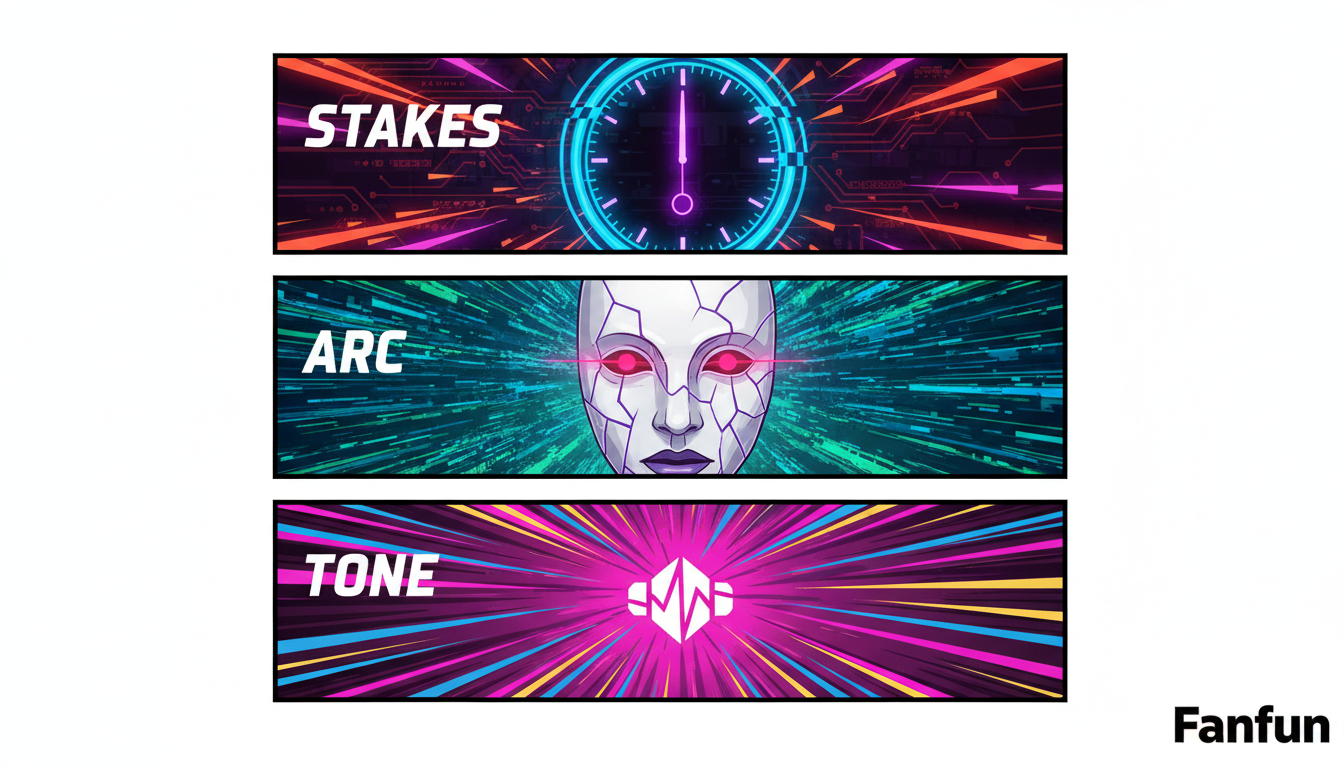
- System Framing: Establish the rules of the world, the current stakes, and the specific power system. Tell the AI what is at stake (e.g., "The city is protected by a failing barrier, and we have exactly ten minutes before the breach").
- Character State: Define where the character is in their personal timeline. An early-series protagonist has different motivations, power levels, and emotional trauma than their post-timeskip counterpart. Specify this state clearly.
- Tone and POV: Set the style of the prose. Do you want third-person limited with heavy emphasis on environmental descriptions, or first-person, fast-paced dialogue?
The Setup Template
When starting your session, copy and adapt this framing template to set the tone immediately:
[Scenario: Post-timeskip. We are standing in the ruins of the central plaza. The rain is heavy, dampening the sound of our footsteps. Tone: Dark, cinematic, high physical stakes. Power System: Cursed Energy. You are playing your character with your signature stubbornness, currently exhausted but refusing to show weakness. Do not speak for my character. Wait for my actions.]
The Battle Scene Blueprint: Co-Writing Action Sequences
The most common pitfall in text-based action roleplay is the "god-mode" trap. This happens when the AI instantly defeats an enemy in a single turn, or conversely, ignores your character's attacks entirely to declare themselves invincible. Real dramatic tension requires struggle, tactical setbacks, and progressive power-scaling.
To avoid this, implement a strict turn-based action framework. Every turn should consist of an Action, a Reaction, a Consequence, and a Counter. When you attack, describe the physical effort and the immediate environment, but leave the damage calculation open for the AI to determine. This keeps the interaction dynamic and unpredictable. For a deep dive into structuring progressive power-scaling and training sequences, check out our master protocol on chatting with virtual anime heroes for immersive roleplay.
| Flat/Generic Chat (What to Avoid) | Dynamic/High-Stakes Roleplay (What to Aim For) |
|---|---|
| User: *I throw a powerful punch at you.*
AI: *I dodge your punch easily and blast you with my energy beam, defeating you instantly. "You can't beat me!" I say.* | User: *I lunged forward, channeling my remaining energy into a heavy right hook aimed at your jaw, ignoring the pain in my fractured shoulder.*
AI: *The blow catches me off guard, sending me stumbling back into the cracked concrete. I spit a trace of blood, a grim smile tugging at my lips. "Not bad... but you left your left flank wide open." I sweep my leg to take your balance.* |
| User: Let's fight the dark wizard.
AI: Sure! I will use my strongest magic spell to defeat the dark wizard right now. We won the battle! | User: *The shadow beast lunges from the canopy. I draw my blade, bracing for the impact.*
AI: *I leap in front of you, my hands trembling as I summon a barrier. The impact cracks the shield, the feedback sending a jolt of pain through my arms. "We can't take this head-on! Find its weak spot while I hold the line!"* |
Breaking the Loop: How to Pivot When the AI Gets Stuck
Even with a perfect setup, AI characters can occasionally fall into repetitive loops. This usually manifests as the AI repeating its signature catchphrase every single turn, constantly agreeing with your plans without offering counter-proposals, or getting stuck in a cycle of endless preparation without ever starting the actual fight.
If your character starts acting like a passive sounding board rather than an active participant, you can use these techniques for treating virtual characters as active scene partners to restore the dramatic tension. When a loop occurs, do not keep replying to the repetitive dialogue, as this only feeds the loop into the AI's short-term memory. Instead, use one of these three diagnostic pivots:
- The Narrative Disruption: Force an immediate environmental change that the AI cannot ignore. Introduce a sudden lightning strike, a collapsing building, or the arrival of an unexpected third party.
- Out-of-Character (OOC) Brackets: Insert a direct system command on a separate line to steer the AI's behavior without resetting the chat. For example:
[OOC: Stop repeating your catchphrase. Focus on your character's growing exhaustion and the tactical difficulty of this fight.] - The Tactical Setback: Voluntarily fail an action. If your character misses a strike, gets trapped, or loses their weapon, the AI is forced to react to a new state of vulnerability rather than maintaining a repetitive, static stance.
From Text to Multi-Sensory Fandom: Elevating Your Creative Projects
Once you have mastered the art of co-writing these high-stakes scenes, your chat transcripts don't have to live forever inside a private archive. Creative fans, web novelists, and content creators regularly use these highly polished dialogues as the foundational scripts for larger creative endeavors. A tense, emotional confrontation co-written with an AI protagonist can easily be adapted into a fan-comic script, a dramatic script for an audio play, or a scene in a custom light novel.
You can take this a step further by bridging the gap between text and audio. Once you have polished your dialogue, you can bring the scene to life by applying professional voice directing techniques to get virtual characters to read your text with genuine emotion using Fanfun's advanced AI Voice Generator. By feeding your co-written script directly into the voice tool, you transition from a simple text roleplay into a fully realized, voiced dramatic scene, complete with the cinematic timing, pauses, and intensity that your story deserves.
How do I prevent an anime AI from breaking character during a long chat session?
To keep the AI in character over long sessions, periodically reinforce the narrative boundaries using Out-of-Character (OOC) brackets. Every 10 to 15 turns, you can insert a brief reminder like [OOC: Maintain your stoic persona and keep your responses focused on the current battle]. Additionally, avoid feeding the AI overly modern or casual phrasing in your own prompts, as it will naturally mirror your writing style.
Can I roleplay as an original character (OC) in an AI anime chat?
Absolutely. When initiating the chat, use the System Framing step to explicitly define your Original Character's name, appearance, abilities, and relationship to the anime protagonist. Keep your OC's power level balanced relative to the protagonist to maintain realistic dramatic tension during training sessions or battles.
What should I do if the anime AI keeps repeating its signature catchphrase too much?
This is a common looping issue. Break the cycle immediately by using an OOC command: [OOC: Please reduce the use of your catchphrase and focus more on physical actions and tactical dialogue]. If that fails, introduce an abrupt narrative shift—such as a sudden attack or an environmental hazard—that demands a completely different emotional response.
How do I set up a multi-character scene or a group battle in a text-based AI chat?
When running a multi-character scene, clearly label who is speaking or acting in your prompts. Use bold names or distinct paragraph breaks for each character's actions. You can also explicitly instruct the AI to control specific secondary characters in your setup prompt, keeping their dialogue distinct from the main protagonist's responses.