The Satirist’s Playbook: How to Script and Voice High-Impact Video Parodies with AI
Great parody isn't just about mocking a voice; it's about capturing the specific vocabulary, cadence, and absurdities of a known archetype. Learn how to write sharp comedic scripts and direct AI voices for flawless timing.
Capturing the spirit of a cultural icon or archetype used to require two things: a rare gift for vocal mimicry and a professional recording studio. Today, the landscape of comedic content creation has shifted, allowing writers to focus entirely on the core of great satire—the writing itself.
Truly memorable parody does not rely on cheap, surface-level impressions. Instead, it thrives on the delicious friction between a highly serious delivery style and completely absurd content. By pairing sharp, structured comedic scripts with modern AI voice tools like Fanfun, creators can now produce studio-grade satire instantly, bringing ambitious concepts to life without the bottleneck of traditional voice casting.
The Anatomy of a Great Parody: Why Cadence Beats Caricature
Parody succeeds when it identifies the "linguistic fingerprint" of the target—their favorite crutch words, sentence structures, and vocal rhythms. If you only mimic the pitch of a voice, the joke wears thin within ten seconds. But if you capture the structural patterns of how a person or archetype speaks, the humor resonates deeply because it exposes their underlying psychology.
Consider how a tech billionaire speaks: the sentences are often short, punctuated by unnecessary pauses, and heavily reliant on words like "fundamentally," "leverage," and "scale." Contrast this with a classic movie trailer narrator, whose voice relies on sweeping, dramatic pauses and an over-reliance on passive, world-ending stakes. The contrast between a highly serious delivery style and completely absurd content is the engine of modern internet satire. When an authoritative voice treats a trivial subject with absolute gravity, the audience cannot help but laugh.
Historically, writing this type of comedy was only half the battle. Creators then had to search for voice actors who could deliver the exact impression needed, which often led to compromised timing or high production costs. Platforms like Fanfun allow creators to bypass the bottleneck of finding voice impressionists, letting them focus entirely on the quality of the writing and the execution of the jokes. With instant access to a diverse library of character interpretations, you can spend your energy refining the script rather than hunting down talent.
Scripting the Satire: A Step-by-Step Writing Framework
A great parody script is structured like a trap. It begins in a place of absolute familiarity, lulling the audience into a false sense of security before pulling the rug out. To keep viewers hooked, especially in short-form video formats, you need a disciplined framework.
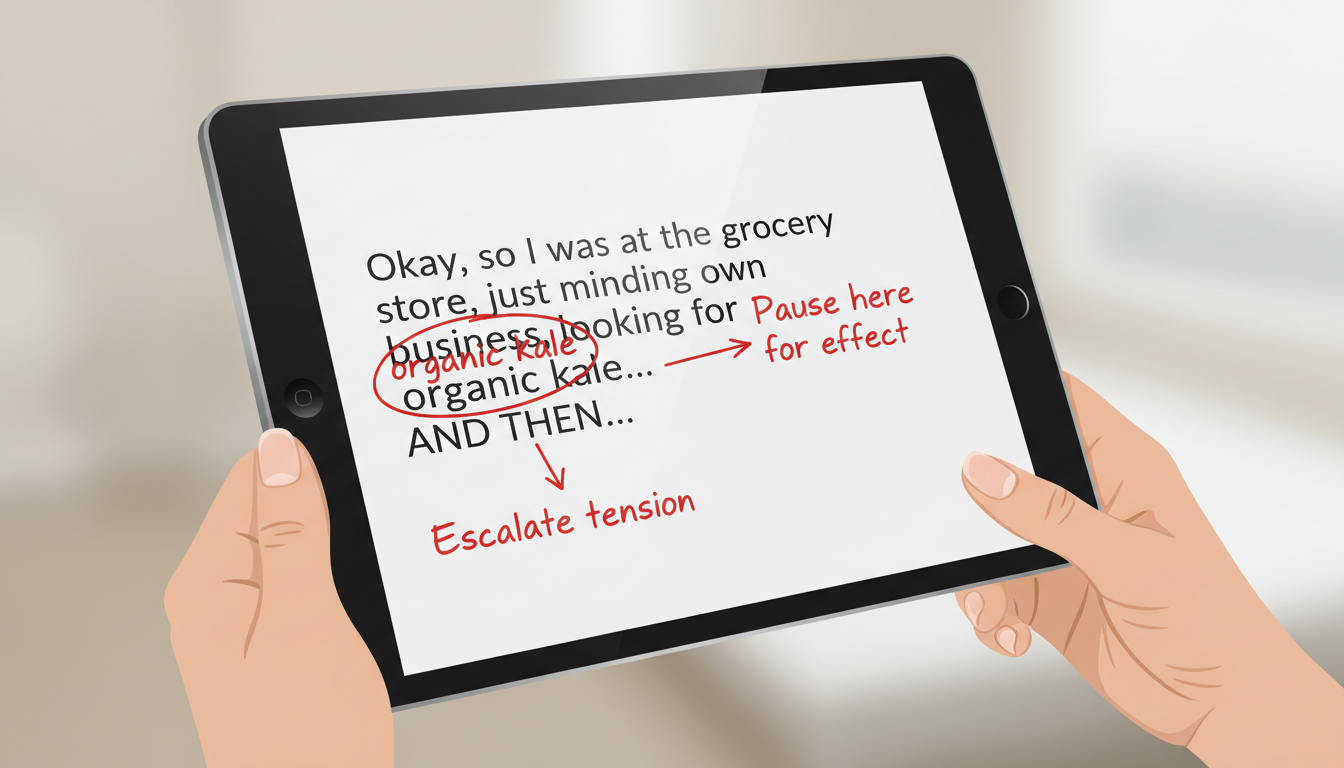
- The Hook (0-3 seconds): Establish the familiar setting or archetype within the first three seconds to anchor the audience's expectations. Use recognizable visual and auditory cues immediately. If you are studying how to structure high-converting video scripts, you know that immediate audience framing is non-negotiable.
- The Escalation: Slowly introduce absurd elements while maintaining the formal tone of the original format. The key is to act as though nothing is wrong. The narrator's tone shouldn't change as they transition from discussing global supply chains to explaining why the office coffee maker is plotting a corporate coup.
- The Punchline: End on a high note of self-awareness or complete subversion rather than letting the joke fizzle out. The final line should reframe the entire premise or deliver a devastatingly accurate critique of the archetype itself.
The Contrast Rule: Juxtaposing High and Low Culture
One of the most powerful tools in a comedy writer's arsenal is the juxtaposition of status. Putting a high-status voice (like a dramatic movie narrator or a tech CEO) into a low-status situation (like losing a sock in the dryer or struggling to assemble a flat-pack bookshelf) is instantly funny.
To make this work, the speaker must remain completely oblivious to the absurdity of their situation. The tech CEO should discuss the missing sock with the same existential dread and strategic corporate jargon they would use for a hostile takeover. This technique is highly effective when using character-driven voiceovers in promotional content, as it allows brands to use self-deprecating parody to make their marketing feel human, self-aware, and genuinely entertaining.
Directing the AI Voiceover: Getting the Perfect Comedic Delivery
Writing the script is only half the battle; directing the AI voice to hit the right comedic beats is where the magic happens. Comedic timing is all about the pause. A joke delivered too quickly gets lost; a joke delivered too slowly loses its punch.

To get the perfect delivery, you must learn to write for the synthetic voice engine rather than just writing for the human eye. AI voice generators read text based on punctuation cues. You can use specific "punctuation hacks" to force the AI to pause for dramatic or comedic effect:
- Ellipses (...): Use these to create a hesitant, thoughtful pause. (e.g., "We decided to launch... the product.")
- Em-Dashes (—): Use these to force a sudden, sharp interruption or shift in thought. (e.g., "It was—to put it mildly—a disaster.")
- Line Breaks: Separating sentences into distinct paragraphs can force the generator to reset its breath, giving the previous line room to breathe.
Additionally, you must match the vocal energy to the visual pacing of your video. A fast-paced, highly edited montage needs a rapid-fire, high-energy voiceover, whereas a slow-burn deadpan joke needs long, agonizing pauses. When directing AI voices for high audience retention, keeping the vocal rhythm dynamic prevents the viewer's brain from tuning out. Use Fanfun's AI voice generator to test different character archetypes, experimenting with different vocal weights and speeds to find the exact tone that elevates your script's subtext.
The Parody Writer's Toolkit: Formats and Templates
To help you kickstart your next project, here is a comparison of three dominant parody formats, along with their key linguistic tropes and structural beats.
| Parody Format | Key Linguistic Tropes | Structural Beats | Target Clichés |
|---|---|---|---|
| The Tech Keynote | "Incredible," "Revolutionary," "We believe," "Fundamentally." | Start with a personal anecdote; introduce a mundane object as a world-saving miracle; end with an absurd price point. | Over-hyped product launches, corporate savior complexes. |
| The Gritty Movie Trailer | "In a world," "One man," "This summer," "Nothing could prepare them." | Establish a bleak landscape; introduce a trivial conflict as an apocalyptic threat; cut to silence; deliver a deadpan line. | Over-dramatic Hollywood tropes, excessive bass drops. |
| The Influencer Apology | "I wanted to come on here," "My truth," "Growing and learning," "Deeply sorry." | Deep sigh; mention of "taking accountability"; pivot to a brand deal, merch drop, or self-promotion. | Insincere creator apologies, performative vulnerability. |
Before you run your script through an AI voice generator, use this quick checklist to ensure your comedy is fully optimized:
- [ ] Does the hook establish the archetype within the first 3 seconds?
- [ ] Are the crutch words of the target persona used naturally but frequently?
- [ ] Does the escalation build steadily without jumping to the extreme too quickly?
- [ ] Have you inserted punctuation cues (ellipses, dashes) to guide the AI's comedic pauses?
- [ ] Is the punchline sharp, self-aware, and concise?
Navigating the Ethics and Legality of AI-Driven Parody
As AI voice technology becomes more accessible, creators must navigate the legal and ethical boundaries of digital satire. Understanding these guardrails ensures your content remains both legally protected and creatively respected.
In the United States, parody is a historically protected form of free speech under the Fair Use doctrine. To qualify as fair use, your content must be transformative—it should use the likeness or voice to comment on, critique, or mock the original work or public figure, rather than simply copying it for commercial gain without added creative value. If your video is clearly a work of humor or commentary, it is generally protected.
However, transparency is critical. Best practices include clearly labeling your content as an "AI Parody" or "AI Voice Interpretation" in the video description or as an on-screen watermark. This maintains trust with your audience and prevents platform algorithms from flag-marking your content as misleading or deepfake misinformation. Finally, adhere to the golden rule of satire: punch up, not down. Focus your humor on the absurdities of public archetypes, corporate structures, and cultural clichés rather than punching down at marginalized groups or spreading malicious misinformation. Keep the comedy focused on the writing and the archetype's inherent quirks.
Is it legal to use AI voice generators for parody videos?
Yes, under United States copyright law, parody is generally protected under the Fair Use doctrine. To qualify, your content must be transformative, meaning it uses the voice to critique, mock, or comment on the subject rather than simply duplicating their work for commercial gain. Always ensure your content is clearly recognizable as satire.
How do I make an AI voice sound more natural and funny?
The secret lies in punctuation and pacing. Use ellipses (...) to create hesitant pauses, em-dashes (—) for sudden interruptions, and exclamation points sparingly. Testing different character archetypes on Fanfun can also help you find the voice that naturally fits the comedic subtext of your script.
What is the best format for a short-form TikTok parody script?
The best format is a fast-paced contrast script. Establish the familiar archetype in the first 3 seconds, escalate the absurdity of the situation over the next 20 seconds, and deliver a sharp, self-aware punchline before the 30-second mark to maximize viewer retention.
Do I need to disclose that my video uses AI-generated voices?
Yes, it is highly recommended. Clearly labeling your video as "AI Parody" or "AI Voice Interpretation" in the description or via an on-screen watermark builds trust with your audience and prevents social media platforms from flagging your content as misleading misinformation.