How to Script Personalized Character Roasts That Actually Land
Want to roast your friends using their favorite characters? Learn the Lore-to-Life framework to turn inside jokes and character lore into comedic gold.
A personalized character roast lands successfully when you contrast a fictional figure’s high-stakes lore with your recipient’s low-stakes, real-world habits. To make the humor work, you must avoid generic insults—like calling someone lazy or old—and instead filter their specific, mundane quirks through the character's unique worldview. While instant video platforms make creation effortless, the comedic payoff depends entirely on balancing character authenticity with affectionate, hyper-specific teasing that the recipient will immediately recognize.
The Anatomy of a Great Character Roast
Generic roasts fail because they lack specificity. A memorable roast thrives on comedic contrast: a powerful space warrior, a cynical detective, or a whimsical cartoon character taking time out of their epic lives to comment on your friend's messy car or bizarre coffee order. The comedy comes from the absurdity of an iconic figure caring about something so trivial.
This contrast is especially powerful when designing digital gifts for friends who live far away. Instead of sending a generic card, a custom character video loaded with specific inside jokes acts as a bridge, reminding them of shared memories and daily routines in a way that feels incredibly deliberate. For a deeper dive into crafting these meaningful connections, see our guide on how to design hyper-personalized digital gifts for long-distance friends.
The 'Lore-to-Life' Scripting Framework
To write a script that sounds like it was penned by the character's actual writers, use the Lore-to-Life Framework. This three-step process translates fictional tropes into personal comedic material.
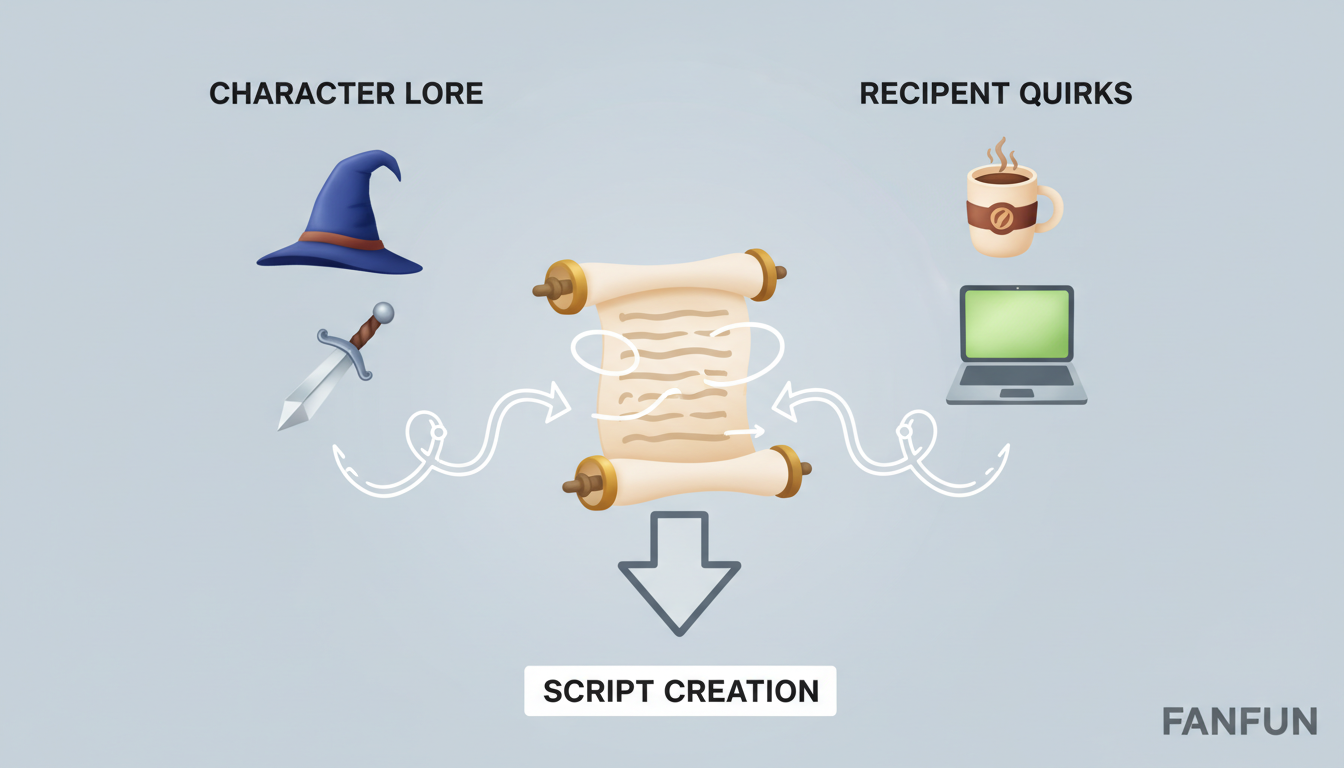
- Step 1: Identify the character's core obsession. What does this character care about most? Is it power, a specific food, order, or fighting monsters?
- Step 2: Map that obsession to the recipient's quirk. Find the real-world equivalent of the character's obsession in your friend's life. If the character hunts monsters, your friend's "monster" might be their pile of unfolded laundry.
- Step 3: Deliver the punchline in character voice. Use the character's specific vocabulary, speech patterns, and worldview to judge the recipient's habit.
The Script Transformation
See how a generic script is transformed using this framework:
- Before (Generic Roast): "Hey Sarah, you are always late and you drink too much coffee. You need to get your life together. Happy birthday!"
- After (Lore-to-Life Roast using a Space Warrior Persona): "Sarah, my scanners indicate you have missed your morning launch window for the third time this week. How do you expect to conquer the galaxy when you are held hostage by a 20-ounce iced caramel macchiato? Clear your desk, fold that mountain of clothes you call a 'clean pile,' and prepare for departure."
Lore-to-Life Mapping Examples
| Character Obsession | Recipient Quirk | Script Translation |
|---|---|---|
| Obsessed with stealth & training | Friend always drops their phone | "Your lack of coordination would alert every guard in the fortress. Invest in a phone case, recruit." |
| Obsessed with magical rules | Friend hoards unread emails | "A dark curse has clearly locked your inbox. 4,000 unread scrolls is dark magic even I cannot break." |
| Obsessed with gourmet food | Friend eats cold pizza for breakfast | "To consume cold cheese on cardboard at dawn is a crime against gastronomy. Your kitchen is a disaster." |
Matching the Roast to the Character's Persona
The delivery style must match the character's established persona to feel authentic. If you are using an aggressive anti-hero, they can handle sharp, direct, and sarcastic jabs. However, if you choose a whimsical cartoon character, the roast should feel playfully naive, confused, or overly dramatic about normal human behavior.
Instead of forcing a famous catchphrase at the very end like a cheap sticker, weave it into the middle of the critique. For example, if a character is known for shouting about power, have them question why your friend lacks the "power" to wake up to their first alarm. For more advanced techniques on capturing a character's behavioral traits, check out our guide on how to simulate authentic character interactions for fan content. Matching the exact vocabulary and speech rhythm ensures the final video feels like a genuine crossover event rather than a generic text-to-speech reading.
If you are adapting this roast format for siblings or family gatherings, the challenge is keeping the teasing balanced so no one feels unfairly targeted. This requires a similar strategy to scripting shared holiday messages, where you distribute the jokes evenly—a technique explored in our guide on how to script personalized Santa videos for siblings.
Optimizing Your Script for AI Video Generation
Even the best script can fall flat if the AI voice generator mispronounces a key word or rushes through a punchline. Because AI models read text sequentially, you must write for the ear, not the eye.
First, use phonetic spellings for unusual names, local slang, or inside jokes. If your friend's name is "Siobhan," write it as "Shi-vawn." If they love a local spot called "Phở 79," spell it out as "Fuh seventy-nine" to prevent the AI from stumbling.
Second, pay attention to sentence structure. Break up long, winding sentences into shorter, distinct statements. Keeping your clauses brief and punchy is the most reliable way to ensure the AI maintains a steady comedic rhythm without rushing. If you are using these videos for a professional setting, such as a colleague's retirement or a lighthearted team milestone, ensure the humor remains safe for work while maintaining high engagement. For more on balancing humor with professionalism, see our analysis of how to use custom AI video messages for business promotions.
When you are ready to generate the video, platforms like Fanfun allow you to turn these scripts into finished videos in minutes. Unlike traditional talent-booking sites where you might wait days or weeks for a response, using instant celebrity AI video alternatives gives you immediate creative control. This rapid turnaround is detailed in our guide on how to generate hyper-personalized character videos in minutes, which outlines how to go from a drafted script to a shareable video before the joke loses its freshness.
How do I write a roast for someone who is sensitive to criticism?
Focus the roast entirely on hyper-trivial, non-serious habits (like their obsession with a specific water bottle brand or their preference for pineapple on pizza) rather than personal insecurities, career status, or relationships. Keep the tone light and affectionate.
How long should a character roast script be for an AI video?
Keep it between 50 and 150 words. This length (roughly 30 to 60 seconds of spoken audio) is the sweet spot for maintaining high energy, delivering 2-3 solid punchlines, and keeping the viewer's attention.