The Conversational Crucible: How to Flesh Out Fictional Characters Through Real-Time AI Chat
Traditional character sheets are dead weight. Discover how to use real-time AI chat to pressure-test your fictional characters, expose their vocal postures, and translate those raw breakthroughs into compelling voice performances.
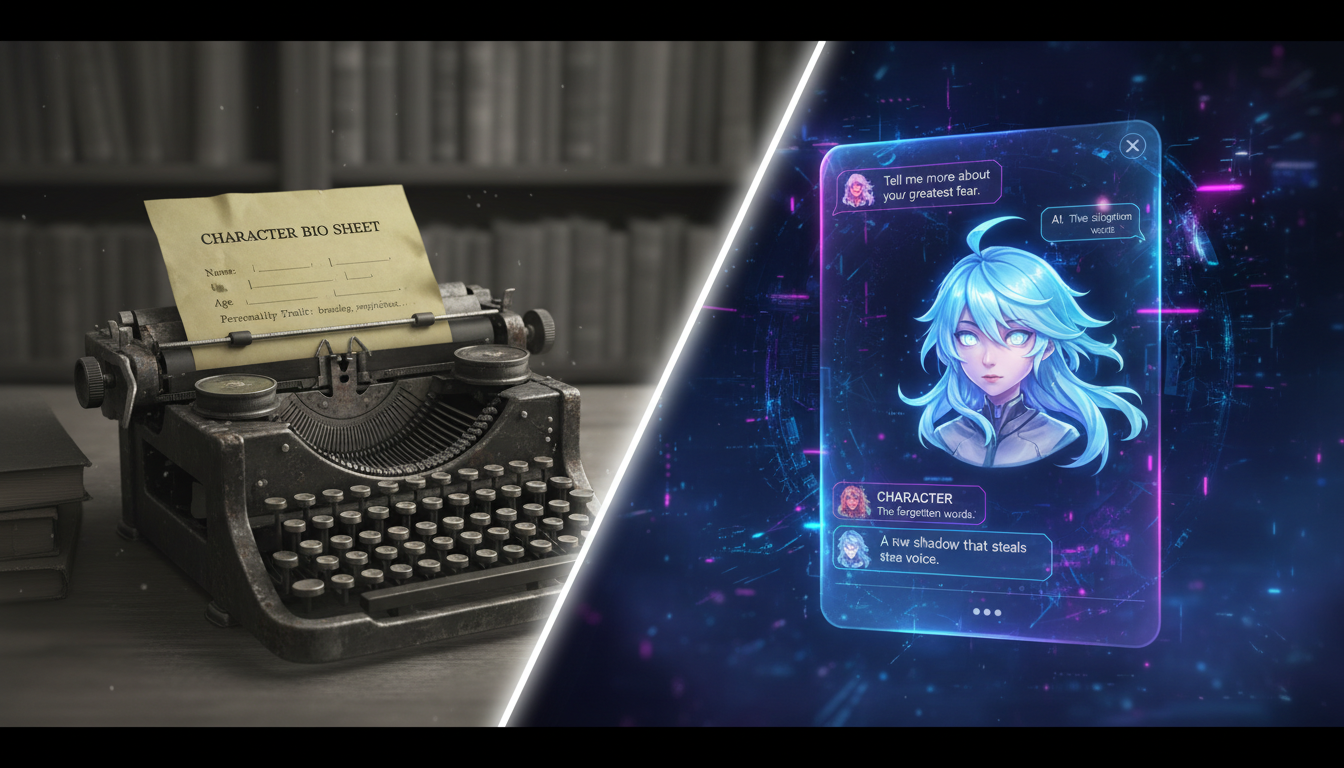
Every writer has been there: staring at a 50-question character development worksheet, dutifully recording your protagonist’s favorite childhood pet, their astrological sign, and their abstract fears. Yet, the moment you drop them into a scene, they speak in flat, predictable sentences that sound suspiciously like your own internal monologue. Static templates can map out a character’s history, but they fail to capture their presence. They cannot tell you how a character behaves when they are cornered, lying, or desperately trying to charm someone they despise.
To break past this creative wall, you need to stop planning your characters and start confronting them. By treating interactive AI chat tools as dynamic sparring partners, you can pressure-test your characters in real-time. This active, improvisational approach forces authentic voice, subtext, and psychological defenses to surface naturally. Using platforms like Fanfun, writers and content creators can shift from passive planning to active interrogation, shaping three-dimensional dialogue before a single line is officially scripted.
The Death of the Static Character Sheet
Traditional character sheets treat personality as a museum exhibit—neatly labeled, categorized, and utterly inanimate. You might know that your detective protagonist drinks black coffee and fears failure, but that doesn’t tell you how they react when a suspect mocks their intelligence. When you rely solely on static templates, your characters lack the spontaneous friction that makes human interaction compelling. They become mouthpieces for plot exposition rather than living, breathing entities with distinct vocal rhythms.
Real human personality is revealed under pressure. We do not walk around reciting our backstories; we deflect, we use humor to mask insecurity, and we adopt different social masks depending on who is watching. This is the concept of “conversational pressure.” To discover your character’s true nature, you must force them to react, defend themselves, and negotiate in real-time.
This is where interactive AI chat shifts the paradigm. Instead of completing a solitary writing exercise, you can input your character’s basic parameters into an AI chat interface and engage with them directly. By stepping into the shoes of an antagonist, a skeptical partner, or an aggressive interviewer, you create a dynamic, live-testing environment. Fanfun’s interactive AI Chat allows you to step out of your solitary comfort zone and co-create with an AI interpretation of your character, transforming a dry drafting phase into an active, improvisational session where authentic dialogue is forged.
Setting Up the Conversational Crucible
To run a successful character stress-test, you cannot simply say, “Let’s chat.” Standard AI models default to polite, helpful, and cooperative behaviors—the exact opposite of what you need for high-stakes drama. You must carefully construct the boundaries of the chat to simulate a high-pressure environment.

Start by setting up a clear frame of conflict. Rather than acting as the supportive creator, adopt a challenging persona. You might play an untrustworthy ally who just stole their supply shipment, an aggressive journalist digging into their past, or their worst nightmare: a parent who never believed in them. If you are struggling with setting up the scene, consider setting up a virtual writer's room to stress-test your plot and character dynamics, which can help establish the core stakes before you begin the interrogation.
When prompting the AI to assume your character’s role, explicitly forbid them from being agreeable. Give them clear, conflicting motivations. For example, if you are testing a rogue character, your prompt might look like this:
“You are Silas, a cynical smuggler who has just been caught red-handed by a city guard (played by me). You are desperate to avoid jail because you have a sick sister depending on you, but you are too proud to show weakness. You will use sarcasm, deflections, and bribes to get out of this. Do not break character, and do not apologize or cooperate easily.”
The 'Stress-Test' Prompting Strategy
Once your scene is set, you need a systematic way to push your character past their polite facade. Use this three-step prompting framework to break through their defenses and discover their authentic voice.
Step 1: The Inciting Question
Begin the session with a targeted question that directly attacks their core vulnerability. Avoid open-ended small talk. If your character is an ambitious young executive who secretly feels like an impostor, do not ask, “How is your job going?” Instead, ask: “Everyone in that boardroom knows you’re completely out of your depth, don’t they?” This forces an immediate defensive posture, revealing how they handle a threat to their ego.
Step 2: The Contradiction Callout
As the character responds, look for logical gaps or emotional deflections in their answers. Call them out on their hypocrisy. If Silas the smuggler claims he only steals to survive, ask him: “Then why did you spend forty gold pieces on a velvet cloak last week while your crew went hungry?” Watching how the AI rationalizes this contradiction will show you whether your character doubles down on their lies, becomes aggressive, or crumbles under guilt.
Step 3: The Ultimatum
Force the character into a corner where they must make a difficult, immediate decision. Give them two bad options with no room for compromise. For instance: “Either you betray your partner right now and walk free, or you both go to the dungeons for ten years.” The choice they make—and the exact words they use to justify it—will reveal their true moral compass far better than any abstract bio sheet ever could.
Spotting the Tells: Analyzing Subtext and Defense Mechanisms
The magic of this process doesn’t happen during the chat itself; it happens when you analyze the transcript. Once you have pushed your character through the crucible, review their responses to identify their unique “vocal posture.” Vocal posture is the linguistic armor a character wears to protect themselves.
Pay close attention to how they structure their sentences when stressed. Does a highly educated character start using overly formal, academic language to distance themselves from an emotional topic? Does a tough-talking warrior start using rapid-fire, short sentences when they are frightened? These are the subtle, non-obvious details that elevate dialogue from generic exposition to rich, subtextual human expression. If you want to dive deeper into this analysis, try using character chat tools to stress-test your dialogue and subtext to see how these linguistic shifts function across different scene structures.
Look for their specific evasion tactics. When you asked Silas about his sister, did he change the subject, counter-attack with an insult, or suddenly become quiet? Map these behaviors. When you write your actual script, ensure these defense mechanisms are present. Instead of having your character state their feelings directly (“I am scared”), have them use the exact deflections, sarcasm, or formal barriers you uncovered during your AI chat session.
From Text to Voice: Translating Chat Breakthroughs into Performance
Uncovering your character’s written voice is a massive victory, but for content creators, filmmakers, and animators, the journey doesn’t end on the page. A brilliantly written script can still fall flat if the spoken delivery fails to capture the underlying subtext. The pauses, the pacing, and the emotional weight must match the psychological profile you just built.

When moving from a raw chat transcript to finished audio, you need tools that let you direct the performance with precision. It is not enough to use a generic, robotic text-to-speech generator; you need to understand how to choose and direct digital voiceover tools for high-retention video edits. This ensures that the sarcasm, the hesitant pauses, and the sudden shifts in vocal posture carry over seamlessly into the final media.
With Fanfun’s advanced AI voice generator, you can instantly bridge the gap between text and performance. Once you have refined your dialogue based on your chat sessions, you can input those lines and select an AI voice profile that matches your character’s newly discovered persona. By hearing your dialogue spoken aloud in minutes, you can immediately identify if a line sounds too stiff, too fast, or out of character, allowing you to iterate rapidly before publishing your final video or audio project.
The Interactive Character Development Framework
To help you implement this workflow in your own creative projects, use the comparison table and checklist below to transition from static, lifeless planning to dynamic, voice-synthesized character creation.
| Development Phase | The Old Way (Static) | The New Way (Interactive AI) |
|---|---|---|
| 1. Setup & Conception | Filling out a 50-question PDF bio sheet. | Creating a high-stakes conflict prompt on Fanfun AI Chat. |
| 2. Interrogation | Imagining hypothetical scenarios in your head. | Running the 3-step Stress-Test (Inciting, Contradiction, Ultimatum). |
| 3. Subtext Analysis | Writing on-the-nose dialogue where characters say what they mean. | Extracting vocal postures, evasion tactics, and linguistic defense mechanisms. |
| 4. Voice Synthesis | Reading lines aloud to yourself in an empty room. | Generating custom character voices using Fanfun’s AI Voice Generator. |
Your Character Creation Checklist:
- Define the Core Vulnerability: What is the one thing your character is desperately trying to hide or protect?
- Choose Your Interrogation Persona: Select an AI prompt persona that will naturally clash with your character’s goals.
- Execute the Stress-Test: Spend 10-15 turns pushing the AI character into a corner using the three-step framework.
- Identify the Linguistic Tells: Highlight 2-3 verbal patterns, defense mechanisms, or sentence structures that emerged when the character was stressed.
- Refine and Script: Rewrite your project’s dialogue using these discovered patterns to replace flat exposition with deep subtext.
- Synthesize the Voice: Pass your finalized script through Fanfun’s AI voice generator to hear your character’s unique rhythm brought to life.
How do I prevent an AI character from breaking character during a chat?
To keep the AI strictly in character, establish rigid boundaries in your system prompt. Explicitly state that the AI must never break character, write meta-commentary, or apologize as an assistant. If the AI begins to slip, use a corrective system prompt mid-chat (e.g., "[System: Stay in character as Silas. Do not address the writer directly]") to pull the model back into the scene.
Can I use AI chat tools to develop original characters, or only existing pop culture figures?
You can absolutely use them for original characters. While pre-trained models excel at existing pop culture figures, you can easily build an original character by providing a concise, high-impact background description in your initial prompt. Focus on their core motivations, flaws, and vocal style rather than endless backstory details.
How do I translate an AI chat transcript into a usable script?
Do not copy and paste the transcript directly. Instead, treat the transcript as raw material. Look for the moments where the dialogue felt electric, natural, or surprisingly tense. Extract those specific phrasings, verbal tics, and defensive reactions, and manually integrate them into your script's formatting.
What is the best way to prompt an AI to act as a difficult or evasive scene partner?
Give the AI a secret objective that directly conflicts with yours. For example, tell the AI: "You have a secret you cannot reveal under any circumstances, and you suspect the user is trying to trick you." This automatically forces the AI to use deflections, change the subject, and adopt a defensive, evasive posture from the very first message.