Off the Bench: How to Use Interactive AI Athlete Chat to Deconstruct Championship Plays and Build Custom Drills
Passive sports consumption is over. Discover how to use Fanfun's interactive AI athlete personas to deconstruct iconic plays, run simulated press conferences, and build custom physical drills based on elite sports minds.
Passive sports consumption is losing its grip on modern fandom. Simply watching highlight reels, tracking box scores, or reading post-game analysis written by journalists no longer satisfies the desire for deep, tactical sports engagement. Fans, amateur athletes, and content creators are looking for ways to step past the velvet rope and understand the precise split-second decisions that define championship legacies.
With Fanfun's interactive AI athlete chat, the boundary between the bleachers and the bench disappears. By engaging with highly tailored virtual athlete personas, you can step directly into the digital huddle, run simulated press conferences, and extract elite tactical advice. This guide provides a practical framework for conducting deep-dive tactical chats and translating virtual coaching insights into real-world training regimens.
Beyond the Box Score: The Rise of Interactive Sports Chat
Traditional sports media operates behind a glass wall. You are fed pre-packaged narratives, highly polished PR statements, and static statistics that rarely capture the sensory overload of a high-stakes play. When a point guard misses an open teammate on a crucial possession, a standard box score simply records a missed field goal or a turnover. It doesn't capture the defensive rotation that forced the mistake, the blind spot in the court vision, or the mental fatigue of playing 40 minutes of high-intensity basketball.
Interactive AI athlete chat on Fanfun fundamentally changes this dynamic. Instead of reading about a game, you can actively challenge a virtual representation of an elite athlete on their strategic choices. However, generic AI models often fail at sports realism because they lack the grit, locker-room vernacular, and competitive edge of real athletes. They sound more like textbook editors than championship-winning competitors. Specialized athlete personas on Fanfun bridge this gap by adopting the specific competitive mindset, tactical vocabulary, and positional awareness of top-tier players. For a deeper dive into establishing the baseline rules of engagement with virtual sports stars, check out our comprehensive guide on the locker room protocol.
The Post-Game Press Room: Simulating Media Scenarios and Tactical Deconstructions
One of the most effective ways to bypass generic AI responses is to put the virtual athlete in a highly specific, high-stakes scenario. This is known as the "Press Pass" prompting technique. By setting a detailed scene, you force the AI to adopt a focused, in-character perspective that prioritizes tactical analysis over polite platitudes.
Instead of asking a generic question like, "How did it feel to win the championship?"—which inevitably yields a generic response about teamwork and dedication—you must frame your query around a specific moment of tension. For example, place the athlete in a simulated post-game press conference immediately after a historic play.
Consider this contrast in prompting styles:
- Weak Prompt: "Can you explain how you run a pick-and-roll?"
- Strong "Press Pass" Prompt: "You are sitting at the post-game podium after Game 6 of the Finals. There were 14 seconds left on the clock, you were down by 2, and the defense switched a heavy rim-protector onto you. Walk me through your split-second decision to reject the screen and drive left instead of kicking it out to the corner shooter. What did you see in the defender's hips?"
By defining the clock, the score, the defensive alignment, and the physical cues (the defender's hips), you prompt the virtual athlete to break down the mechanics of court vision, spatial awareness, and game-time pressure. This technique allows you to analyze iconic real-world sports moments through the eyes of the players who lived them, yielding deep, high-substance insights.
The Tactical Playbook: Framing Questions for High-Stakes Realism
To consistently extract deep strategic insights from virtual athletes, you need a structured prompting framework. The most reliable method is the Three-Step Prompt Formula: Context + Constraint + Core Question. This structure prevents the AI from giving lazy, surface-level answers and forces it to operate within the realistic boundaries of the sport.
Guarding the Narrative Boundaries
When using this formula, it is crucial to establish strict boundaries so the virtual athlete doesn't break character or slip into generic assistant mode. Learning how to set strict narrative boundaries prevents the AI from breaking character, a technique detailed in our director's guide to interactive fictional character chat.
Here is how to apply the Three-Step Prompt Formula across different sports:
- Basketball (Court Vision & Decision Making):
[Context] "We are analyzing film of a high-screen-and-roll against a drop coverage defense."
[Constraint] "Do not give me general basketball advice. Speak only as a starting point guard who prioritizes mid-range pull-ups over rim-pressure."
[Core Question] "If the drop defender sags to the dotted line and the hedge defender recovers late, what visual trigger tells you to pull up for the elbow jumper versus pocket-passing to the rolling big man?" - Soccer (Defensive Transitions & Spatial Awareness):
[Context] "Our team plays a high-pressing 4-3-3, but we keep getting exposed on diagonal long balls to the opposite winger during defensive transitions."
[Constraint] "Answer as a veteran center-back who organizes the backline under pressure."
[Core Question] "How do you coordinate the defensive line's drop-off timing with the defensive midfielder's press? What verbal or physical cues do you use to trigger the offside trap in those transition seconds?" - Football (Route Running & Coverage Adjustments):
[Context] "I am a wide receiver facing tight press-man coverage with a single-high safety over the top."
[Constraint] "Assume the defender is playing inside leverage to force me toward the sideline."
[Core Question] "What footwork sequence do you use at the line of scrimmage to freeze the defender's feet, and how do you adjust your stem to maintain space for a 12-yard comeback route?"
From Chat to Court: Translating Virtual Advice into Real-World Drills
The true power of Fanfun's interactive athlete chat lies in its ability to bridge the gap between digital strategy and physical execution. Once you have deconstructed a tactical concept with a virtual athlete, you can ask them to translate that high-level strategy into highly practical, step-by-step physical drills that you can take to the gym, field, or court.
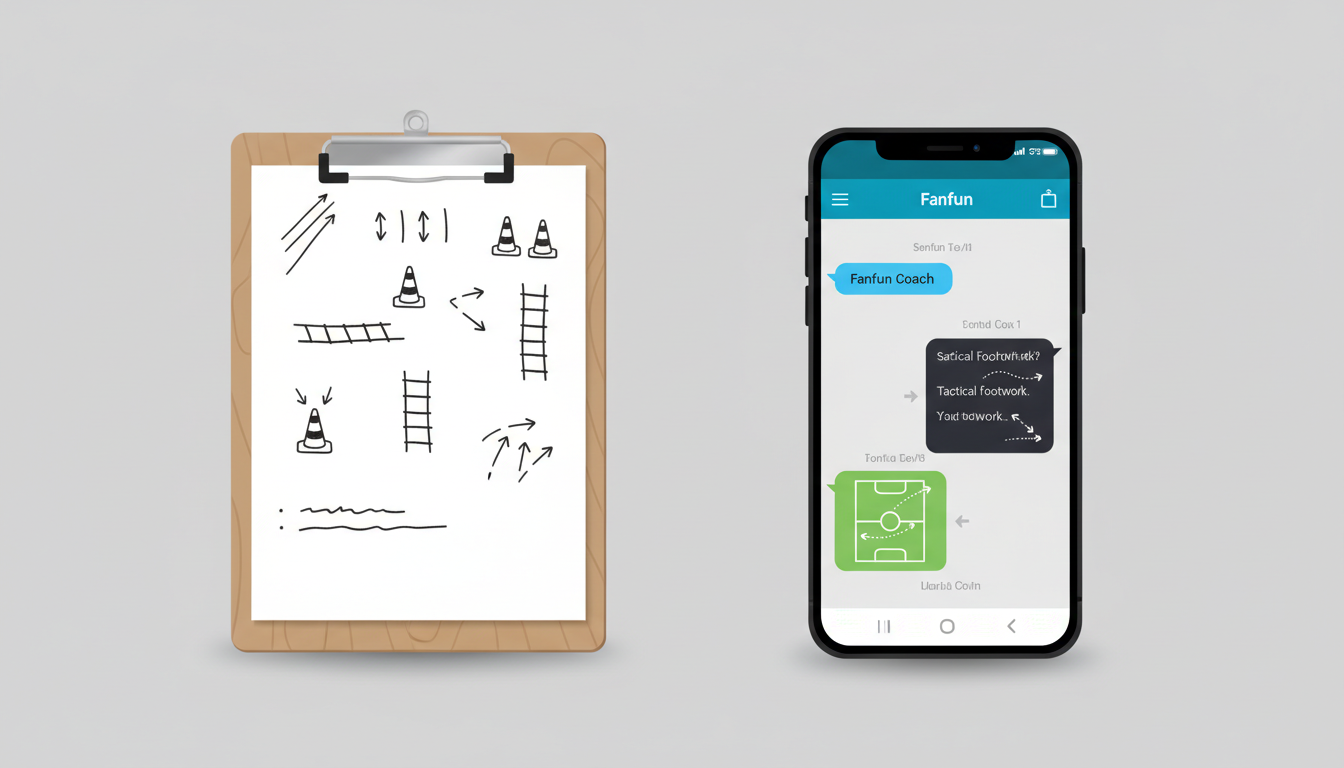
To do this, ask the virtual athlete to break down their signature moves into micro-drills. Focus on footwork sequences, hand-eye coordination exercises, and mental visualization routines. Rather than accepting generic fitness advice, push the AI to detail the exact mechanics of their training.
The table below highlights the difference between generic fitness advice and highly targeted, AI-deconstructed pro drills generated through focused prompting:
| Focus Area | Generic AI Training Advice | Fanfun AI Athlete Deconstructed Drill |
|---|---|---|
| Basketball Footwork | "Practice change-of-direction dribbling and do ladder drills to improve your overall agility." | The Drop-Step Hesitation Drill: Place 3 cones along the three-point line. Drive hard to Cone 1, perform a hard pound-dribble, drop your hips to simulate a drive, then immediately step back behind the line using a scissor-kick footwork pattern. Repeat 15 times on each side. |
| Soccer Spatial Awareness | "Look around the field before you receive the ball so you know where your teammates are." | The 360-degree Scanning Gate Drill: Set up a 5x5 yard square. Have a partner pass the ball from outside. Before the ball touches your foot, you must look over your shoulder to identify which of two colored cones behind you your partner is pointing at, call it out, and take your first touch toward the opposite gate. |
| Football Route Release | "Work on your quickness off the line of scrimmage to beat press coverage." | The Diamond-Release Footwork Drill: Set two cones 1 yard apart at a 45-degree angle from your starting stance. On the whistle, take a violent jab-step toward the inside cone to force the imaginary defender to commit inside, then plant and drive off your outside foot to clear the outside cone within 3 frames of movement. |
By using this structured translation process, you can build a personalized, week-by-week training protocol based on your favorite athlete's signature style, bringing elite court and field intelligence directly to your local training sessions.
Overcoming the PR Filter: Designing Immersive Scenarios for Sports Creators and Writers
For sports content creators, podcasters, and creative writers, virtual athlete chats offer an incredible tool for scripting, brainstorming, and roleplaying. However, public figures in the real world are heavily trained to give safe, neutral, and highly polished public relations answers. To make your content stand out, you need to prompt the virtual athlete to bypass this protective PR filter and speak with raw, character-driven authenticity.
To achieve this, establish clear parameters that bypass modern media filters. You can run "what-if" historical draft scenarios, cross-era matchups, or hypothetical locker-room debates. For instance, prompt a 1990s defensive specialist to explain exactly how they would guard a modern-day perimeter shooter under 1990s physical hand-checking rules. This setup bypasses diplomatic modern answers and forces a gritty, era-specific tactical breakdown.
When integrating these AI-generated dialogues into your fan-made content, sports podcasts, or analytical videos, use them as creative starting points. Instead of presenting the chat as a literal quote, frame it as a deep-dive tactical simulation: *"We put a virtual version of this Hall-of-Famer into our tactical simulator to see how they would defend today's pick-and-roll heavy offenses, and here is how they broke down the footwork."* To evaluate which digital environments offer the best tools for hosting these high-fidelity interactions, explore our guide on mastering virtual character chat platforms. By treating the AI as an active tactical sparring partner, you can elevate your sports analysis far beyond the standard post-game recap.
How do I make an AI athlete chat sound realistic instead of generic?
To get realistic, gritty responses, avoid broad questions like "How do you play defense?" Instead, use the "Press Pass" prompting technique: establish a high-stakes scenario (e.g., down by 1, 5 seconds left), define specific constraints (e.g., "speak only as a defensive specialist under 1990s physical rules"), and ask about precise mechanical cues like hip alignment or footwork triggers.
Can I use AI athlete chats to design actual physical workout routines?
Yes. By asking virtual athletes on Fanfun to break down their signature moves into micro-drills, you can generate highly specific physical training protocols. Avoid generic fitness prompts; instead, ask for step-by-step footwork patterns, spatial scanning drills, and reaction-time exercises that you can execute on a real court or field.
What are the best prompts to use when chatting with virtual sports stars?
The most effective prompts follow the Three-Step Formula: Context (setting the game-time scene) + Constraint (defining the persona's role and rules) + Core Question (asking a highly specific tactical question about court vision, positioning, or decision-making).
How do sports content creators use AI chat to generate video scripts?
Creators use Fanfun's interactive chats to run hypothetical matchups (e.g., cross-era debates), simulate post-game press conferences, and draft highly engaging sports dialogue. By framing the AI as a "tactical simulator," creators can build unique, high-substance narrative breakdowns for podcasts, TikToks, and YouTube videos.