The Art of Affectionate Savagery: How to Write a Roast Script for Your Best Friend (That Won't Ruin the Friendship)
Roasting a best friend is a high-wire act. Discover how to write a script that is brutally funny, deeply affectionate, and safe for your friendship—plus how to deliver it with theatrical flair.
Standing up to roast your best friend is a high-stakes tightrope walk. You want to leave the room in stitches, but you also want to make sure you actually have a best friend when the applause dies down. The secret to a legendary roast isn't holding back entirely; it is understanding that the absolute funniest burns are rooted in deep intimacy and affectionate exaggeration.
A brilliant roast celebrates a person by magnifying their quirks rather than attacking their character. By structuring your script with comedic precision and choosing an unexpected delivery channel—like having an absurdly epic fictional character or a celebrity voice from Fanfun deliver the lines—you can turn what could have been an awkward moment into a highlight of the night. Here is how to master the art of affectionate savagery without crossing the line.
The Golden Rule of the Roast: Affectionate Savagery
The foundation of any great comedy roast is what we call the Roast Ratio: 80% specific, lighthearted teasing to 20% genuine, heartfelt affection. If you go 100% savage, you look like a bully. If you go 100% affectionate, you have written a boring toast, not a roast. The crowd wants to laugh, but they also want to feel the warmth of your connection. Your job is to make the audience think, "Wow, they must really love each other to say something that hilarious."
To achieve this balance, you must abandon generic insults. Telling your friend they are "old," "lazy," or "bad with money" is lazy writing. It doesn't land because it isn't unique to them. Instead, look for hyper-specific observations. Do they still use a Hotmail account in 2024? Do they have a bizarrely intense relationship with their air fryer? Do they spend three hours researching a $15 purchase on Amazon? These tiny, real-world eccentricities are comedic goldmines because everyone in the room will instantly recognize them as true.
Finally, always remember to punch up. Even when roasting a peer, treat their odd habits as endearing superpowers that have gone slightly off the rails. If your friend is incredibly organized, don't call them boring; frame them as a military general whose battle campaigns consist entirely of planning a weekend trip to Target. This reframing keeps the mood light and ensures the target of your jokes feels seen, not targeted.
The Roast Hazard Map: Safe Zones vs. Danger Zones
Before you start drafting punchlines, you need to map out your material. A joke that kills among your college buddies at 1:00 AM can cause a freezing chill to sweep through a room when delivered in front of your friend's grandmother at a rehearsal dinner. Knowing how to navigate these social dynamics is key to learning how to script a funny roast message without the cringe.
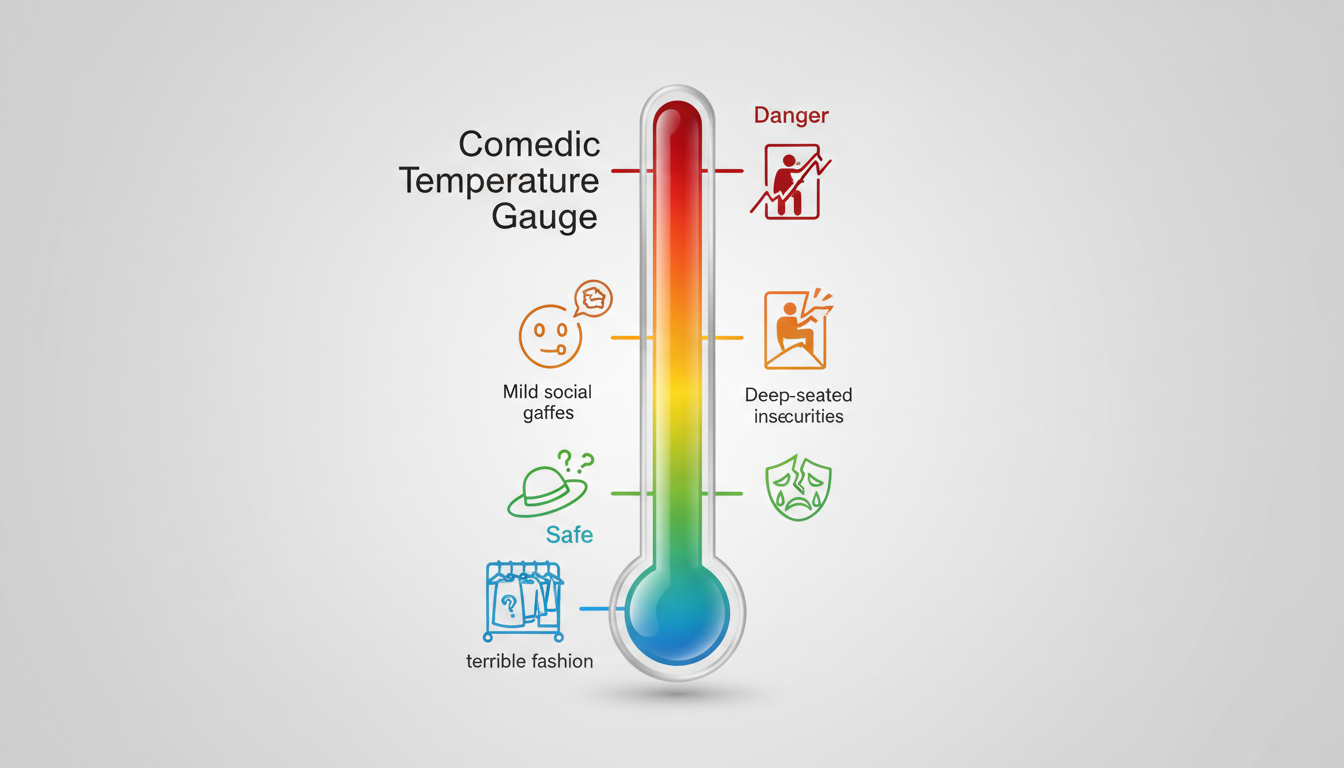
Use the framework below to audit your joke ideas before they make it into your final script:
| Safe Zones (Green Light) | Danger Zones (Red Light) |
|---|---|
| Obsessions with weird hobbies or niche interests | Genuine, deep-seated personal insecurities |
| Terrible fashion choices from high school or college | Past romantic relationships or exes |
| Minor domestic quirks (e.g., terrible parallel parking) | Real career struggles, layoffs, or financial issues |
| An over-the-top love for a specific food, brand, or pet | Family drama or sensitive personal history |
To successfully navigate these zones, you must also gauge your audience. A private birthday party with close friends allows for a slightly edgier script, whereas a major milestone event with family present requires a broader, gentler touch. Regardless of the venue, always buy yourself a license to roast by starting with a quick joke at your own expense. Self-deprecation shows the audience that you don't take yourself too seriously, which instantly lowers their defenses and prepares them to laugh at your friend.
Structuring the Script: Setup, Misdirection, and the Punchline
Good comedy is a science, and its primary formula is expectation versus reality. A classic joke structure relies on a Setup (establishing a normal expectation), a Misdirection (leading the listener's mind down a specific path), and the Punchline (the sudden, unexpected twist). Without this structure, your roast is just a list of complaints. With it, it is a performance.
The Power of the Rule of Three
The human brain naturally looks for patterns. The Rule of Three is a classic writing technique where you list three things: the first two establish a pattern of normalcy, and the third completely shatters it. It is incredibly effective for roasting. For example, instead of saying, "Sarah loves her dog, her husband, and coffee," you write: "Sarah is known for her loyalty. She would do absolutely anything to protect her husband, her beautiful golden retriever, and her absolute right to ignore any phone call from an unknown number."
The "Compliment Sandwich" Technique
If you have a particularly sharp burn that you are dying to use, wrap it in a compliment sandwich. This technique hides a devastating observation between two highly flattering statements. It softens the blow of the joke while keeping the momentum of the roast moving forward. Here is an example of how to rewrite a flat statement into a sharp, rhythmic joke using this technique:
- Flat Statement: "Dave is a really good lawyer, but he is incredibly stubborn and never admits when he is wrong."
- The Compliment Sandwich Rewrite: "Dave is easily one of the most brilliant legal minds I know. He has an unmatched ability to argue any point with absolute conviction—which is incredibly helpful in the courtroom, and incredibly terrifying when he is trying to convince a fast-food cashier that his expired coupon is legally binding. But seriously, his dedication to his clients is inspiring."
Elevating the Delivery: Scripting for AI Character Voices
Even the most brilliant script can falter if the delivery feels forced or nervous. If you are worried about your public speaking skills, or if you want to add a layer of theatrical absurdity to the event, delivering the roast through a third party is a total game-changer. This is where directing celebrity personas for comedy that lands becomes your secret weapon.
Using an AI platform like Fanfun to generate your roast message completely changes the dynamic of the room. When a legendary action hero, a beloved anime icon, or a famous cultural figure is the one calling out your friend's terrible driving, the personal sting vanishes. It becomes an epic, hilarious piece of media that the entire party can enjoy together. Suddenly, you aren't just giving a speech; you are presenting a custom cinematic moment.
To make an AI-generated roast work, you must write specifically for the voice you choose. If you select a dramatic, heroic voice on Fanfun, use grand, apocalyptic vocabulary to describe mundane activities (e.g., "He faced his greatest challenge yet: assembling an IKEA coffee table without losing his mind"). If you choose a quirky character, weave in their signature catchphrases. Additionally, use punctuation to guide the AI's timing. Use ellipses (...) to create dramatic pauses before a punchline, and use exclamation points or capital letters to emphasize key words. This ensures the AI voice generator nails the comedic pacing perfectly.
The Plug-and-Play Roast Script Template
Ready to write your own? Below are two customizable templates designed to work flawlessly with the Fanfun AI voice generator. Simply choose your tone, fill in the brackets, and copy-paste the text directly into the platform to generate your video message.
Option 1: The Mild & Sweet Roast (Perfect for family gatherings)
"We are all here to celebrate [Friend's Name]. A person of true integrity, incredible style, and an absolutely baffling dedication to [insert their weirdest hobby or obsession]. I have known [Friend's Name] for [number] years, and in that time, I have watched them achieve so many incredible milestones. They have conquered their career, built a beautiful life, and yet... they still haven't figured out how to [insert a harmless, simple task they struggle with, e.g., load a dishwasher correctly]. But that is what makes them so special. They are a true original. Let's raise a glass to [Friend's Name]—the only person I know who can [insert a funny, endearing habit]. We love you!"
Option 2: The Spicy & Savage Roast (Best for close friends)
"I was thrilled when I was asked to say a few words about [Friend's Name]. Mostly because I have been waiting years to publicly address their absolute worst habit: [insert habit, e.g., replying to text messages three business days late]. Seriously, [Friend's Name] is a true visionary. They look at a [insert a normal item, e.g., a simple clothing item or a menu] and think, 'How can I make this incredibly complicated?' But in all seriousness, they are the kind of friend who would literally give you the shirt off their back... mostly because they bought it on clearance and desperately need an excuse to go back to [insert their favorite store]. To [Friend's Name]—the legend, the myth, the person who still owes me twenty dollars."
By taking one of these templates and deploying an AI roast video generator for maximum impact, you can create a highly professional, incredibly funny keepsake. Your friend won't just laugh in the moment—they will end up saving the video to watch whenever they need a reminder of how much they are loved, and how hilariously flawed they truly are.
How do you roast a friend who is highly sensitive?
If your friend is sensitive, focus your roast entirely on positive, exaggerated traits rather than flaws. For example, roast them for being "too nice," "too organized," or "obsessively clean." This keeps the tone incredibly light and affectionate while still allowing for funny, theatrical punchlines.
What are some safe topics to roast someone about?
Safe topics include harmless quirks like their coffee order, their love for a specific sports team, their terrible fashion choices from high school, their inability to wake up early, or their hyper-specific, non-offensive hobbies.
How long should a friend roast script be?
A great roast should be short, punchy, and sweet. Aim for 1 to 2 minutes of spoken text, which is roughly 150 to 300 words. Anything longer risks losing the audience's attention and diluting the impact of your best jokes.
How do you recover if a roast joke bombs?
If a joke fails to get a laugh, don't ignore it. Acknowledge it instantly with a self-deprecating comment like, "Well, that sounded a lot funnier in my head," or "And that's why I'm not a professional writer." The audience will appreciate your honesty and laugh at your recovery.