The Art of the Roast: Why Great Satire Needs More Than Just Bite
True critique is a creative act that requires more than just snark. Learn how to build meaningful commentary and use AI personas to refine your delivery.

In the digital landscape, there is a persistent confusion between meaningful critique and performative negativity. While the internet often rewards the loudest voice in the room, true satire is a deliberate, surgical act that requires more than just a sharp tongue. It is the art of highlighting a contradiction or a systemic flaw, forcing an audience to look at a familiar subject through a new, often uncomfortable, lens. To master this, you must treat your commentary as a piece of architecture: it needs a foundation, a structure, and a purpose.
High-substance commentary succeeds because it is rooted in reality. When you strip away the performative elements of a roast, you are left with an argument that must stand on its own merits. Whether you are analyzing a cultural trend, a public figure, or a piece of media, the effectiveness of your critique depends on your ability to balance wit with genuine insight. This is where modern creators are finding new ways to iterate, using tools like Fanfun to experiment with delivery and tone in ways that were previously impossible. By decoupling the message from the physical limitations of traditional production, you gain the freedom to test how your satire lands when delivered through different archetypes.
Beyond the Snark: Defining High-Substance Commentary
Trolling relies on reactive, surface-level insults, whereas high-substance commentary is a deliberate, creative act. Effective satire requires research-backed insights and a clear understanding of the target, ensuring that the argument holds weight even when the tone is biting. The difference lies in intent: constructive satire highlights a contradiction or a flaw in logic, while mindless negativity merely seeks to provoke. If your content is purely reactionary, you are at the mercy of the algorithm's volatility. If it is analytical, you build a foundation of trust with your audience.
To remain engaging, a creator must maintain a consistent voice. If your audience cannot identify the 'why' behind your critique, the message loses its impact. By grounding your arguments in verifiable reality, you transform a simple roast into a persuasive piece of content that encourages your audience to think critically rather than just react emotionally. This requires a shift in mindset from 'what can I say to get a reaction' to 'what can I say to change the perspective of my viewer.'
The Role of Persona in Digital Persuasion
Audiences connect more deeply with a defined character than a generic narrator. A persona acts as a vehicle for your message, allowing you to inhabit a specific point of view that might be too abrasive or too formal for your personal brand. When you adopt a character, you create a layer of creative distance that allows for sharper satire, as the audience understands the critique is framed through a particular lens. This is why many creators are turning to AI-driven personas to act as the 'voice' of their commentary.
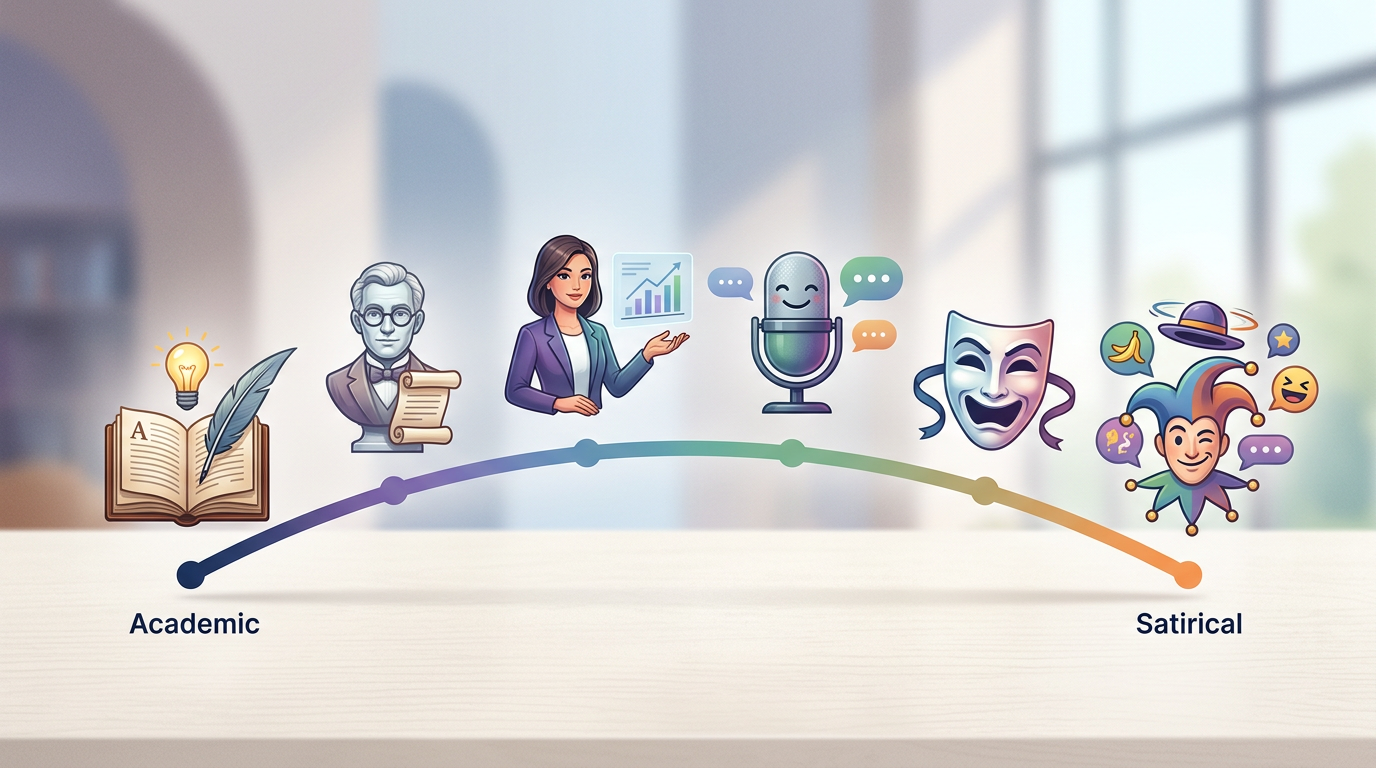
Using an AI voice generator allows you to iterate on this delivery style without the friction of traditional production. Experimenting with tone is essential; a critique delivered by a stoic, authoritative figure like Shaq carries a different weight than one delivered with the high-energy, nostalgic optimism of Spongebob Squarepants. This creative freedom allows you to test which rhetorical style best serves your argument before committing to a final edit. You can even lean into the gravitas of a sports legend like Kobe Bean Bryant to add a layer of intensity to your commentary that a standard voiceover simply cannot match. By choosing a persona that contrasts with the subject matter, you create a 'dissonance effect' that makes the satire stickier and more memorable.
Framework for a Balanced Critique
To ensure your commentary is effective and avoids the trap of ad hominem attacks, use the Fact-Feel-Focus model:
- Fact: Start with a verifiable observation or a piece of data. Avoid hearsay; use the raw material of the topic as your anchor.
- Feel: Acknowledge the emotional response or the cultural tension behind the topic. This is where you humanize the critique.
- Focus: Reiterate the core argument or the specific takeaway you want the audience to have. This is your 'so what' moment.
Before publishing, ask yourself: Is this critique actionable? Does it address the issue rather than the individual? Is the tone appropriate for the platform? Sometimes, the best way to avoid an echo chamber is to test your script with a completely different vocal delivery style to see if the message survives the shift in presentation. If your argument falls apart when the persona changes, the issue isn't the delivery—it's the substance of the critique itself.
Iterating Your Content with AI Tools
The modern content creator needs to move faster than the traditional production cycle allows. Fanfun provides an ecosystem where you can instantly generate content to test how a script lands when delivered by varied personalities. For instance, you might find that a script meant to be a harsh critique feels more poignant or absurd when voiced by an iconic figure, creating a jarring, memorable contrast with your biting words. This is not just about convenience; it is about creative optimization.

This iterative process is at the heart of the future of digital commentary. Instead of agonizing over a single take, you can generate multiple variations in minutes. This is where the Dwayne Johnson AI or the classic, recognizable tone of Mickey Mouse become essential tools for your workflow. They allow you to pivot your tone instantly based on the specific segment of your video, ensuring that your content feels dynamic and responsive to the topic at hand. When you use The Rock Dwayne Johnson persona, for example, you are tapping into a specific cultural frequency of intensity and charisma that can elevate a dry script into something high-stakes.
Scaling Your Creative Output Without Sacrificing Depth
Scaling your output does not have to mean sacrificing quality. By moving away from the constraints of scheduled celebrity bookings and toward an AI-driven workflow, you gain the ability to produce high-frequency content that stays relevant to breaking news cycles. Having a library of personas at your fingertips means you can assign different 'voices' to different segments of your content, keeping the experience fresh for your viewers. This is a massive advantage for creators who need to maintain a daily or weekly cadence without losing their unique editorial voice.
Consistency is key to growth, but burnout is the enemy of creativity. By leveraging tools that provide instant, high-quality audio and video assets, you can maintain a rigorous publishing schedule without the logistical burden of traditional production. The goal is to spend more time on the substance of your critique and less time on the mechanics of delivery, ensuring your content remains both intellectually sharp and creatively resonant. When you stop worrying about the 'how' of production, you can focus entirely on the 'why' of your message. Ultimately, the best satire is that which forces the viewer to confront a truth they hadn't considered—and with the right persona, that confrontation becomes much more engaging.
How do I improve my commentary style for YouTube?
Focus on the 'Fact-Feel-Focus' model: ground your critique in reality, acknowledge the emotional stakes, and ensure your core argument remains the primary takeaway for the viewer.
What makes satire effective instead of just mean?
Effective satire targets ideas, contradictions, or systems rather than individuals. It uses wit and framing to highlight absurdity, whereas being 'mean' relies on ad hominem attacks that offer no substance.
How can I use AI to help with my content creation process?
AI allows you to instantly iterate on your delivery style. By using different AI personas, you can test how a script sounds with various tones and voices to find the most impactful way to communicate your point.
Are there better alternatives to traditional celebrity booking for content creators?
Yes. Platforms like Fanfun provide instant access to AI personas, allowing for immediate content generation without the cost, scheduling, or availability issues associated with traditional celebrity bookings.