The Roleplayer's Codex: How to Direct Immersive Anime AI Chats That Don't Break Character
Ditch the flat, out-of-character responses. Learn how to act as a narrative director to build deep, lore-accurate anime roleplay experiences using advanced prompt structures and real-time AI tools.

For years, anime roleplay meant waiting. You would spend days crafting a detailed character sheet, post it on a forum or a dedicated Discord server, and then wait hours—sometimes weeks—for your partner to reply with a single paragraph. Today, the landscape has completely shifted, transforming passive fans into active narrative directors who can co-create sprawling stories in real time.
With the rise of sophisticated AI engines, you no longer have to wait on someone else's schedule to explore the streets of Neo-Tokyo or challenge a legendary sorcerer. Platforms like Fanfun have turned character interaction into an instant, high-fidelity experience, allowing you to run deep, immersive roleplay sessions whenever inspiration strikes. However, getting an AI anime character to maintain its distinct voice, respect complex lore, and avoid repetitive loops requires a strategic approach.
The Evolution of Anime Roleplay: From Forums to Real-Time AI Engines
Classic "para-style" roleplay on forums was built on mutual patience and creative stamina. Writers spent hours agonizing over vocabulary, formatting, and character consistency. While this style produced beautiful, novelistic stories, it lacked momentum. If a partner lost interest, the entire narrative arc collapsed. Modern AI-driven interactive chat preserves the creative depth of those classic forums but supercharges the pacing, delivering instant responses without sacrificing the unique quirks of your favorite characters.
This evolution represents a massive shift from passive media consumption to active, participatory storytelling. Instead of merely watching an anime episode or reading a manga chapter, you control the plot, the stakes, and the dialogue. Fanfun's interactive AI Chat is designed specifically to bridge this gap, providing a platform where static fandom becomes a living, breathing dialogue. By interacting with AI personas that understand their own canon, you can test theories, explore "what-if" scenarios, and build entirely new realities on the fly.
Setting the Scene: How to Frame Your Roleplay Prompts for Maximum Lore Accuracy
The most common mistake in AI roleplay is starting with a generic opening. If you begin a session with "Hi, how are you?", the AI is forced to pull from generic, conversational datasets. This instantly flattens the character's unique voice, turning a fierce warrior or a sarcastic anti-hero into a polite, overly agreeable virtual assistant. To prevent this, you must treat your very first message as a director's brief.
To build a foundation before diving into advanced prompting, check out our comprehensive guide on how to master anime character AI chat. Once you understand the basics, your primary focus should be establishing the "World State" in your opening turn. This means defining the physical environment, the current timeline, and any immediate external pressures. For example, rather than letting the AI guess where you are, explicitly state if you are standing in a rain-slicked alleyway in Shibuya or resting inside a medieval guild hall.
Equally important is defining your own character's role. Whether you are playing an Original Character (OC) or another canon figure from the same universe, the AI needs to know how its persona should relate to you. Establishing this relationship dynamic immediately gives the AI a behavioral counterweight, guiding how defensive, friendly, or formal its responses should be.
The "First Message" Formula
To consistently launch high-fidelity roleplay sessions, use a structured formula for your opening prompt. A successful first message must contain three essential components: Context (the setting and mood), Action (what your character is physically doing), and an Open-Ended Hook (an invitation for the AI to react).
Consider the difference between a low-effort opening and a high-fidelity, narrative-rich opening:
- The Low-Fidelity Opening:"Hey, I'm a new student at the academy. Do you want to train with me?" (This offers no sensory details, no tension, and forces the AI to invent the entire setting.)
- The High-Fidelity Opening:"The sun is setting over the academy training grounds, casting long shadows across the stone floor. I stand in the center of the ring, catching my breath as I wipe sweat from my forehead, my wooden practice sword still raised. I look over at you leaning against the wooden fence. 'You've been watching me for an hour,' I call out, challenging your gaze. 'Are you actually going to draw your weapon, or are you just here to critique my stance?'"
Deconstructing the High-Fidelity Prompt
The high-fidelity prompt works because it establishes immediate sensory details (the setting sun, stone floor, sweat) and places the AI character in a specific physical position (leaning against the wooden fence). It also introduces a clear emotional tension and ends with a direct, open-ended question that forces the AI to respond in character, matching the established pacing and tone.
Keeping the AI in Character: Handling Lore Drift and Out-of-Character (OOC) Moments
Even with a perfect opening, long roleplay sessions can suffer from "lore drift." Because AI models operate within a finite memory window, they can eventually forget critical details established early in the conversation. When this happens, the character might suddenly forget that they are injured, ignore a major plot twist, or start using modern slang that doesn't fit their fantasy setting.
To combat this, you can use subtle narrative re-injection. Instead of stopping the story to correct the AI, weave the forgotten details back into your descriptive action. If the character forgets they are trapped in a dungeon, write: *I look around the damp, locked stone cell, reminding us both of our escape plan as I whisper...* This keeps the immersion intact while updating the AI's active memory context.
To deepen your control over these conversational dynamics, explore our advanced strategies on how to master anime character AI chat to prevent behavioral drift. When subtle hints fail, you can use bracketed Out-of-Character (OOC) commands. Placing instructions inside brackets—such as [OOC: Keep your responses in character, maintain your cold demeanor, and do not fast-forward the scene]—allows you to guide the AI's behavior directly without contaminating the actual story text.
Interactive Formats: Choosing Between Text, Voice, and Video Responses
Modern roleplay is no longer confined to reading text on a flat screen. Multi-modal AI technology has introduced a level of sensory immersion that early forum roleplayers could only dream of. Hearing a character's distinct vocal tone, sigh, or dramatic pause adds a profound layer of emotional resonance that text alone cannot fully replicate.
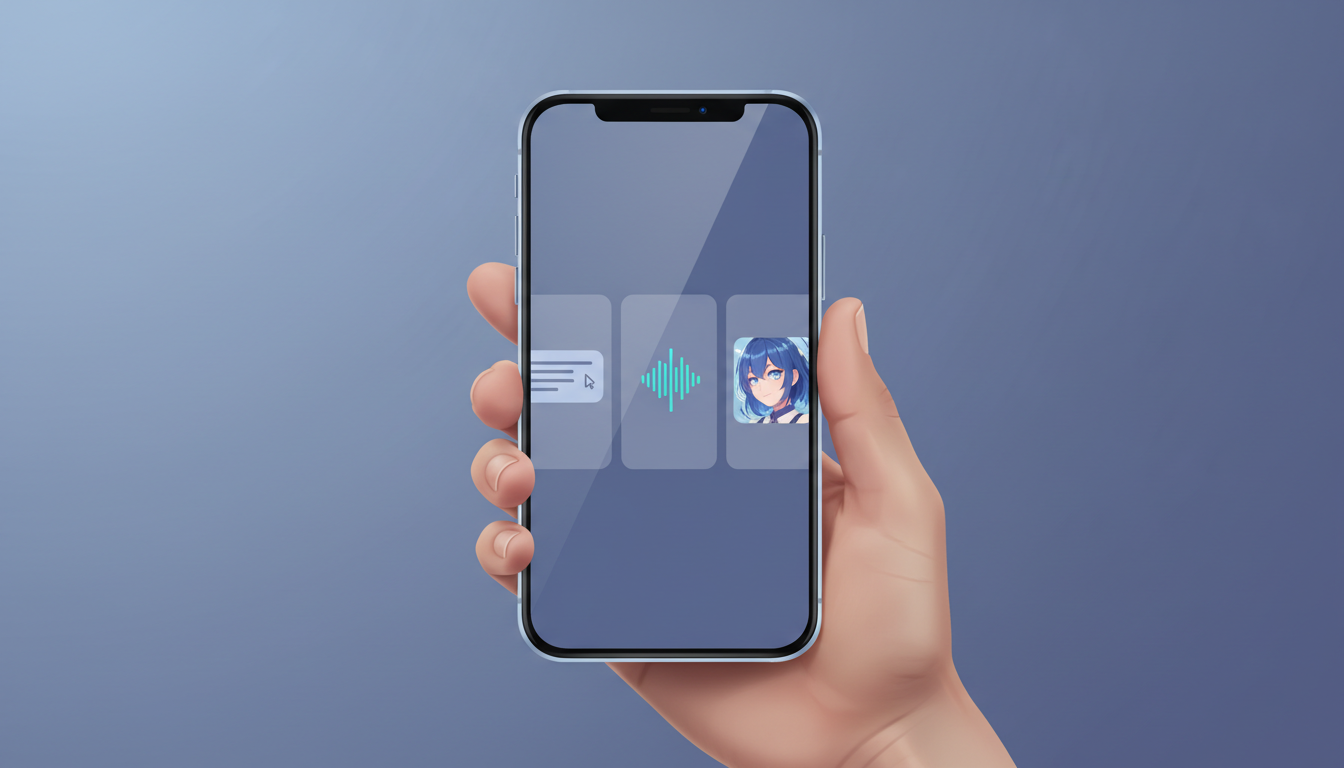
For a complete breakdown of how to navigate these diverse formats, read our complete guide to Fanfun's instant video, voice, and interactive chat tools. Within the Fanfun ecosystem, you can seamlessly transition from text-based dialogue to generating custom voiceovers or even personalized video messages. This flexibility allows you to match the medium to the narrative moment.
For example, use text chat to handle complex world-building, tactical combat maneuvers, and long-form exposition. Then, when the story reaches a major emotional peak—such as a dramatic confession, a declaration of rivalry, or a celebratory victory speech—transition to voice or video formats. Having the character deliver their key lines aloud makes the climax of your roleplay session feel incredibly real.
The Roleplayer’s Toolkit: A Comparison of AI Chat Styles
Every roleplayer has a preferred narrative pace. Some want quick, witty banter to pass the time, while others want to write a multi-chapter fantasy epic. To get the best results from your sessions, you must align your prompt style with your creative goals.
| Roleplay Style | Primary Focus | Prompt Structure | Pacing Strategy |
|---|---|---|---|
| Casual Chat | Quick conversational banter, light humor, and daily check-ins. | Short, single-sentence dialogue with minimal descriptive action. | Rapid, turn-based back-and-forth. Keep responses under two sentences. |
| Literate Roleplay | Deep character development, emotional arcs, and world-building. | Multi-paragraph prose combining internal thoughts, sensory details, and dialogue. | Slow, deliberate pacing. Focus on one specific interaction or scene per turn. |
| Action & Combat | Tactical encounters, magic systems, and physical conflicts. | Descriptive physical movements, environmental hazards, and clear declarations of intent. | Turn-based resolution. Describe your action and wait for the AI to determine the outcome. |
By identifying your creative goals early, you can structure your prompts to signal the desired format to the AI. If you want a Literate Roleplay experience, consistently feed the AI rich, descriptive paragraphs; if you want rapid-fire combat, keep your actions punchy, immediate, and high-stakes. With Fanfun's diverse character library, you can easily find the perfect AI persona to match your chosen style, ensuring your next collaborative adventure never breaks character.
How do I start an interactive anime roleplay chat online?
To start, choose a platform like Fanfun and select your desired anime character. Instead of sending a simple greeting, write an opening prompt that establishes a specific scene, defines your character's role, and ends with an action or question that invites the AI to react in character.
Can AI anime chat bots remember long-term roleplay storylines?
AI models have a limited memory window (context length). Over long sessions, they may begin to forget early plot details. You can manage this by occasionally re-introducing key plot points naturally into your descriptive actions or by using bracketed OOC commands to remind the AI of the current context.
What is the best way to keep an anime AI from going out of character?
The best way is to provide rich, descriptive prompts that match the character's native universe. Avoid generic conversational language. If the AI begins to drift, use bracketed instructions—like [OOC: Maintain your canon personality traits]—to guide it back without breaking the narrative flow.
How do I use OOC (Out of Character) commands in AI roleplay?
OOC commands are written inside brackets at the beginning or end of your message (e.g., "[OOC: Keep your response focused on the battle]"). This tells the AI's underlying engine to treat the text as an instruction rather than dialogue spoken by your character, helping you steer the plot seamlessly.