The Punchline Problem: Why AI Comedy Needs More Than Just a Famous Voice
Comedy relies on the gap between expectation and reality, but most AI-generated humor falls flat because it misses the timing. Discover how to master the script-to-cadence workflow to create viral, perfectly timed digital roasts.

Comedy relies on the gap between expectation and reality, but most AI-generated humor falls flat because it completely misses the timing. You can have the most accurate voice clone in the world, but if it delivers a punchline with the steady, unyielding rhythm of a GPS navigation system, the joke is dead on arrival. The technology has evolved past simple text-to-speech, yet many creators still treat AI voice generation like a basic copy-and-paste exercise, wondering why their digital roasts fail to get a laugh.
The secret to viral AI comedy isn't the voice itself—it’s the script-to-cadence workflow. Creators who consistently land digital laughs understand how to mimic the distinct rhythms, pauses, and vernacular of legendary performers. By treating the AI not as a magic trick, but as a digital performer that requires precise stage directions, you can transform a flat text prompt into a delivery that actually breathes and connects with an audience.
The Anatomy of a Digital Roast
"Generic funny" does not exist in the world of AI voice generators. Humor is inextricably linked to persona. When you write a script for a digital roast, the vernacular must match the specific tropes of the character you are channeling. If you write a sarcastic, dry-wit joke meant for a cynical comedian and feed it to a highly enthusiastic sports persona, the cognitive dissonance might be mildly amusing for a second, but the core joke will fail.
Consider the intensity required for certain archetypes. Writing a script for a Dwayne Johnson AI requires a high-octane, intense vocabulary filled with dramatic pauses, theatrical confidence, and a cadence that builds to a crescendo. You have to write words that demand to be shouted or delivered with a raised eyebrow. If you feed that exact same aggressive script to a soft-spoken cartoon character, the delivery will flatten the punchline.
To succeed, you have to write for the medium. Shorter, punchier scripts consistently outperform long-form AI monologues. AI voices can sometimes struggle to maintain comedic momentum over three or four dense paragraphs without sounding monotonous. Keep the setup tight, establish the premise immediately, and make sure the punchline hits before the viewer has a chance to scroll away.
Mastering the Cadence: A Practical Framework
The mechanics of a joke don't change just because a machine is delivering it. The classic three-beat rule—setup, misdirection, punchline—remains the gold standard for comedic writing. But how do you force an AI to respect that rhythm? The answer lies in how you format the text before you ever hit the generate button.
The Punctuation Hack for Comedic Timing
AI voice engines read punctuation as literal stage directions. A period is a standard breath. A comma is a micro-pause. But when you need that crucial beat of silence before the punchline drops—the pause that lets the audience realize they are about to be surprised—you have to manipulate the text. Using ellipses (...) or em-dashes (—) forces the engine to hesitate. Sometimes, phonetically spelling out a sigh (e.g., "*sigh*" or "Ugh...") gives the AI the contextual cue it needs to drop the pitch of its voice, adding a layer of exasperation that sells the joke.
Before you finalize your generation, run your script through this Comedy Audit Checklist:
- The Breath Test: Read the script out loud exactly as punctuated. If you don't naturally pause where the commas are, the AI won't either. Adjust the punctuation to match natural human breath patterns.
- The Syllable Count: Are the words too complex? AI voices occasionally stumble on multi-syllabic jargon, ruining the flow. Swap "utilize" for "use" or "fabrication" for "lie" to keep the delivery crisp.
- The Vernacular Check: Does this sound like something the persona would actually say? If the vocabulary doesn't match the character's known public persona, the illusion breaks.
- The Punchline Placement: Is the funniest word at the very end of the sentence? (e.g., "You look like a wet owl" hits harder than "A wet owl is what you look like.") End on the hard consonant or the most ridiculous visual.
Choosing Your Comedic Archetype
Selecting the right persona is half the joke. Different AI profiles lend themselves to entirely different styles of humor, and matching your script to the right archetype is critical for the punchline to land. You are not just choosing a sound; you are choosing a comedic vehicle.
The "Big Personality" approach relies on larger-than-life figures to deliver self-deprecating or highly exaggerated humor. Using a Shaq persona to deliver a deadpan critique of your friend's terrible recreational basketball skills works because the voice carries inherent authority, warmth, and a booming presence. The joke is amplified by the sheer contrast between the speaker's legendary status and the incredibly mundane subject matter of the roast.
Conversely, the "Nostalgia" approach subverts expectations. Taking a beloved childhood voice, like a Spongebob Squarepants AI, and having it deliver dry, corporate jargon or highly ironic observations creates instant comedic friction. Hearing a hyper-optimistic cartoon sponge complain about a 401k matching policy is inherently funny because it shatters the established context of the character.
This is exactly why Fanfun gives creators the flexibility to experiment with these personas instantly. The ability to test the exact same punchline across a legendary athlete, an intense action star, and a cartoon character lets you find the perfect comedic delivery in minutes rather than days. You can A/B test your comedy in real-time.
When to Use AI vs. Real Performers
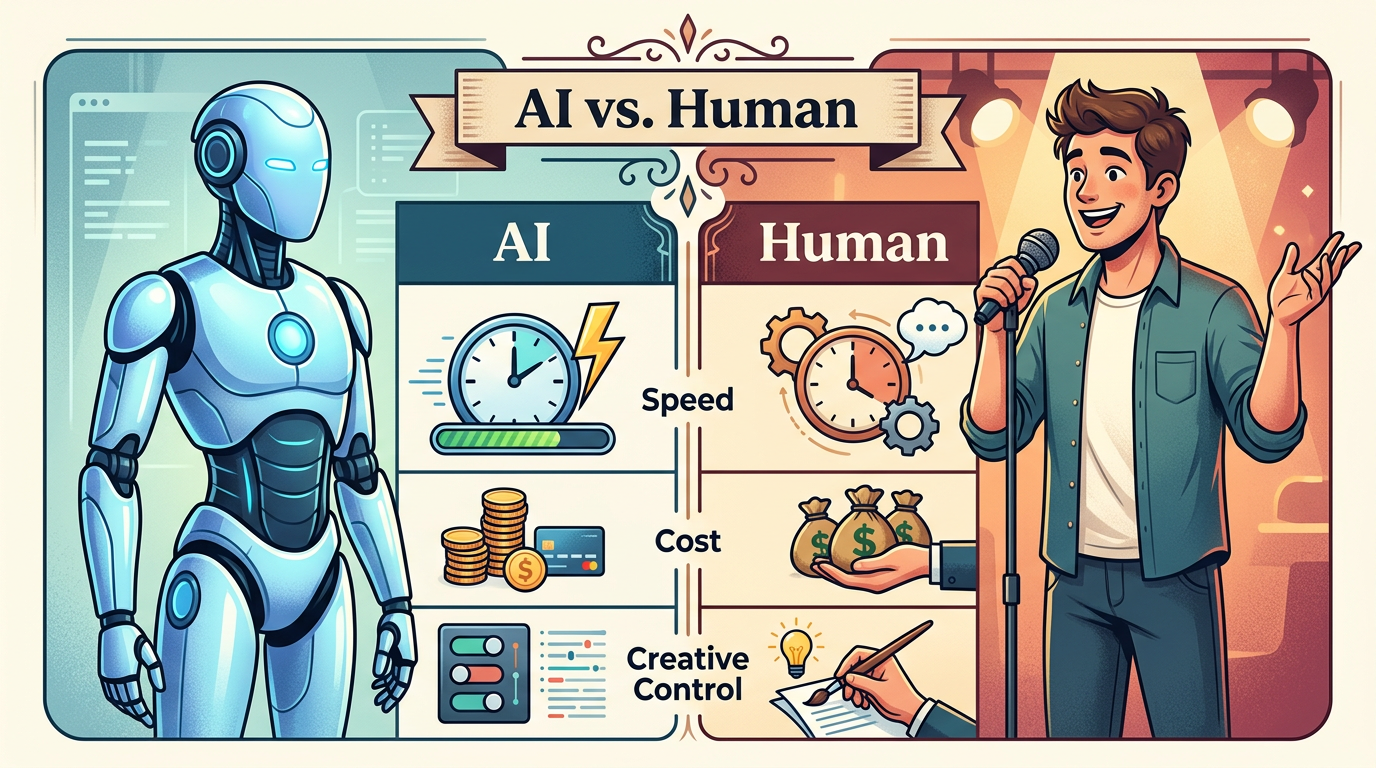
There is certainly a time and a place for booking a human impressionist or a real celebrity, but digital content creation operates at a speed that traditional talent booking simply cannot match. When deciding between hiring human talent and utilizing AI tools, the primary factors are scalability, creative control, and speed.
Internet trends move in hours, not weeks. If you need a reaction video to a pop culture moment that happened this morning, waiting three to five days for a Cameo delivery means missing the viral window entirely. AI provides the "instant factor" necessary for modern social media algorithms. You can write, generate, and publish a highly relevant roast or meme in under ten minutes.
| Feature | AI Persona (Fanfun) | Human Impressionist / Celebrity |
|---|---|---|
| Turnaround Time | Instant (Minutes) | Days to Weeks |
| Cost per Video | Highly affordable, subscription or token-based | Expensive, varies by celebrity status ($50 - $1000+) |
| Script Control | 100% control over exact phrasing and timing cues | Subject to performer's interpretation and ad-libs |
| Revisions | Unlimited tweaks to punctuation and pacing | Rarely offered without additional high fees |
| Best Use Case | Trending memes, high-volume social content, daily uploads | One-off premium gifts, high-budget commercial campaigns |
The Future of Synthetic Comedy
We are rapidly moving past passive video clips and one-way voiceovers. The next frontier of digital humor is two-way interactive conversation. As AI chat capabilities become more sophisticated, fans are no longer just writing static scripts; they are engaging in real-time improv with their favorite personas.
Fanfun’s interactive chat features allow for a spontaneous back-and-forth that mimics the rhythm of actual comedic banter. You can throw a ridiculous scenario at an AI athlete or an anime character and see how they react in character, on the fly. This shift from static generation to dynamic interaction makes the comedy feel alive, entirely personalized, and unpredictable in the best way possible.
However, this incredible creative freedom comes with an ethical responsibility. As the barrier to creating highly realistic, persona-driven comedy drops to near zero, creators must ensure their content remains fun and respectful. The goal of synthetic comedy should be to celebrate fandom, elevate memes, and share a laugh—not to deceive, defame, or cause harm. By focusing on smart writing, impeccable timing, and choosing the right archetypes, creators can push the boundaries of digital humor while keeping the joke exactly where it belongs: in the craft of the script.
How do I make my AI voice sound more natural and less robotic?
To make an AI voice sound natural, you need to write for the AI engine. Use punctuation strategically: periods for full breaths, commas for micro-pauses, and ellipses (...) or em-dashes (—) to force longer comedic pauses. Additionally, keep your sentences relatively short and use vernacular that specifically matches the persona you are generating.
Can I use AI voices for professional comedy skits?
Yes, many content creators successfully use AI voices for YouTube, TikTok, and Instagram Reels skits. The key to making them sound professional is mastering the script-to-cadence workflow—ensuring the timing, archetype matching, and punchline placement are tightly edited rather than relying entirely on the novelty of the voice itself.
What are the best alternatives to Cameo for instant comedic content?
Fanfun is a premier alternative to Cameo, specifically designed for instant generation. Unlike traditional booking platforms where you wait days for a response, Fanfun allows you to generate personalized roasts, birthday wishes, and memes in minutes. It also offers fictional and animated characters that are impossible to book on traditional platforms.
How does Fanfun handle the timing of AI-generated comedy?
Fanfun's AI models are highly responsive to text formatting. The engine interprets your punctuation as behavioral cues. By auditing your script for syllable count, breath placement, and using specific punctuation marks to force hesitation, you have granular control over the comedic pauses necessary for a punchline to land perfectly.